Table of Contents
Your firm holds trust account funds, privileged matter records, and an extensive network of outside counsel relationships that run on professional trust. Every one of those creates a specific opening for attackers.
Most cybersecurity guides name the threats — phishing, ransomware, business email compromise — then move on.
This article does something different: each section breaks down how a specific threat actually works inside a law firm’s daily operations, what makes it more dangerous in a legal context, and what the warning signs look like before the damage is done.
Why Law Firms Are a Specific Target, Not Just a Generic Business
The Trust Account, the Matter Record, and the Client Relationship
Three things separate your firm from a generic business target.
The trust account is a legal instrument. If an attacker redirects funds held in trust, your firm may be financially liable to the client regardless of whether those funds are recovered. The financial exposure compounds with potential bar discipline.
The matter record is privilege-protected. A breach that exposes privileged communications or work product doesn’t just create a technical problem — it creates a legal one.
The outside counsel network runs on trust. Your firm works with co-counsel, opposing counsel, title companies, and court staff who are treated as known parties. That trust is exactly what attackers exploit.
Why Firm Size Doesn’t Reduce Exposure
If you’re a smaller firm, it’s tempting to read what follows and assume cybersecurity for law firms is a large-firm problem — it isn’t.
Most cyberattacks are automated and volume-driven — a solo practitioner’s email is as likely to be compromised as a 200-attorney firm’s. The difference isn’t who gets targeted — it’s who has the infrastructure to detect and respond when it happens.
Smaller firms usually don’t.
Business Email Compromise and Trust Account Wire Fraud
How the Attack Actually Works
BEC targeting law firms isn’t a sophisticated, targeted operation from the start — it’s a numbers game.
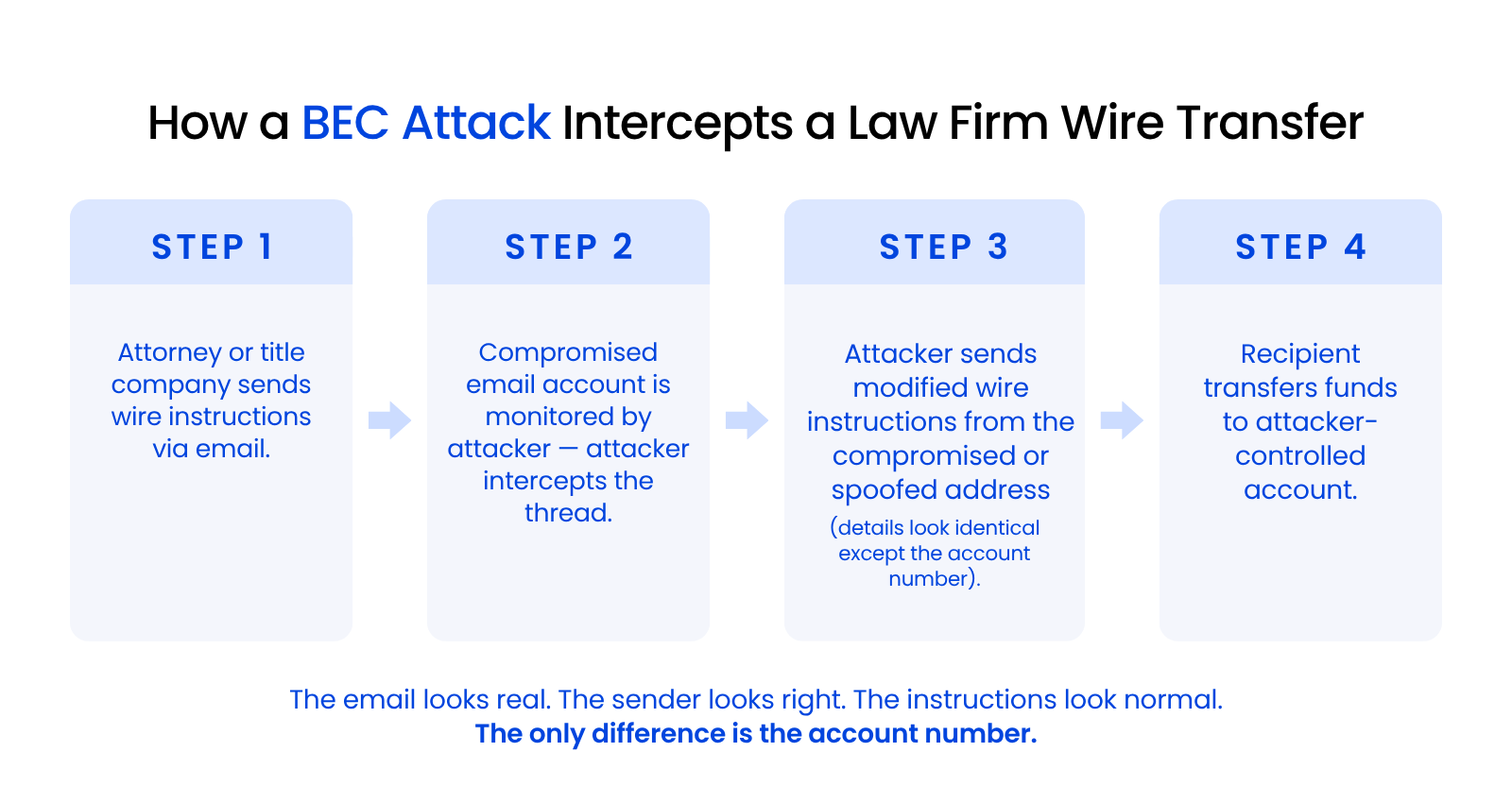
Attackers compromise email accounts at scale using phishing campaigns or credential stuffing, then monitor those inboxes for the right moment. In a law firm, that moment is a real estate closing, a settlement disbursement, or a trust account transfer. When it arrives, the attacker intercepts the email thread with modified wire instructions sent from the compromised account.
The request looks legitimate because almost everything about it is — the only thing that changes is the account number. By the time anyone notices, the funds are in an account the attacker controls and are often unrecoverable.
What Makes It Specifically Dangerous in Legal Transactions
A trust account disbursement isn’t a standard business payment — it represents funds your firm holds in a fiduciary capacity.
If those funds are redirected, your firm may be financially liable to the client independent of any recovery effort. Bar discipline exposure compounds the financial one. The combination makes BEC the most consequential attack pattern in the legal industry.
Warning Indicators

Phishing and Outside Counsel Impersonation
How Spear Phishing Works against Lawyers Specifically
Mass phishing is spray-and-pray; spear phishing against your firm is the opposite.
Attackers use publicly available information to construct plausible context: court filings, press releases, LinkedIn profiles, bar association directories. They know the case name, the opposing parties, and sometimes the timeline.
The email isn’t generic bait — it references a specific matter with specific details, which is exactly what lowers your guard.
The Outside Counsel Impersonation Vector
Your firm operates in a high-trust communication environment. Emails from opposing counsel, courts, title companies, and clients are acted on quickly because that’s how legal work moves.
A spoofed email from a known co-counsel’s domain, referencing an active matter, requesting action under deadline pressure, is functionally indistinguishable from a legitimate message without technical verification. The urgency framing — a court deadline, a filing window — is deliberate.
Why Standard Anti-Phishing Tools Create False Confidence
Anti-spam filtering stops mass phishing at the perimeter. Spear phishing bypasses it by design, because the message references real information and often comes from a legitimate or near-legitimate domain.
The deeper issue is what happens after credential theft. Once an attacker has a valid username and password, standard two-factor authentication often isn’t enough.
The attacker isn’t breaking in at that point — they’re logging in as you.
That’s the gap that identity threat detection and response (ITDR) is designed to close. In one case handled by Uptime Legal’s security team, a managing partner’s email was compromised. The firm had declined conditional access management, but 24/7 identity threat detection was in place. The account was shut down in four and a half minutes from the time of breach, before a single email went out. The next morning, the account was verified clean and brought back online.
Warning Indicators
Cybersecurity for Law Firms:
A Practical Guide for Firms Without a Security Team For a broader look at how these threats fit into a firm’s overall security approach.
Ransomware Timed to Firm Deadlines
How Ransomware Attackers Time Their Strikes
Ransomware hits every industry, but the timing in legal attacks is rarely random.
Attackers who’ve established access to a firm’s network often sit quietly for weeks or months before executing. They aren’t waiting randomly — they’re watching. Trial prep windows, merger closing dates, and court filing deadlines represent moments when a firm’s cost of losing access is at its highest.
Deploying encryption in that window creates leverage that makes the ransom conversation go differently.
What Operational Paralysis Looks Like in a Legal Context
A ransomware attack doesn’t just disrupt operations — it locks everything simultaneously: matter files, correspondence, research, case management, billing.
Missing a statute of limitations or a court deadline because of a ransomware attack isn’t just an operational disruption — it may constitute a professional failure.
The more concerning pattern is double extortion: exfiltrating privileged communications, client data, and financial records before encrypting the network. The firm doesn’t just face a ransom demand to restore access. It faces a threat to publish or sell client data if the ransom isn’t paid.
Warning Indicators
Insider Threats and Access Control Gaps
The Access Control Failure Mode That Surprises Firms Most
The most common access control failure at law firms isn’t a malicious insider — it’s a partial offboarding.
When an attorney or staff member departs, the Microsoft account typically gets disabled first. But legal SaaS tools — practice management, document management, e-billing platforms — each have their own credentials. Disabling the Microsoft account doesn’t touch them.
A departed associate can retain active logins to those systems for months.
In one case documented by Uptime Legal, a firm discovered that an employee who had been gone for six months still had access to two separate legal software platforms. Nobody had checked. Nobody knew.
Why Law Firm Practice Transitions Are a Specific Exposure Point
Attorney departures, lateral hires, and of-counsel arrangements create access control transitions that are easy to manage badly. A lateral joining from another firm may be provisioned to every system on day one before anyone has assessed what access level they actually need.
An attorney who leaves for a competitor retains any access that wasn’t proactively revoked. Depending on what was accessed and when, this may not be just an IT problem — it may be a bar ethics issue involving client confidentiality.
Over-Provisioned Access as a Background Risk
The broader pattern is over-provisioning: granting access rights at onboarding and never revisiting them. Support staff end up with permissions to matters they have no current role on. Of-counsel have access to file repositories that extend far beyond their engagements.
That’s not a malicious design — it’s the path of least resistance. The risk is that a single compromised credential now grants access to far more than it should.
Warning Indicators
Credential Compromise and Legal SaaS Account Takeover
Why Legal SaaS Tools Are a Specific Target
Practice management, document management, e-billing, and matter tracking tools collectively hold the most operationally sensitive data in a firm: active matters, client correspondence, financial records, court calendars.
These tools are often protected by weaker configurations than core email — separate credential sets, inconsistent MFA enforcement, and access patterns that haven’t changed since onboarding.
How Credential Stuffing Reaches Legal Accounts
Credential stuffing doesn’t require phishing. Attackers use username and password combinations from prior data breaches — lists that are bought and sold on the dark web — and test them at scale against web applications.
Legal SaaS platforms have predictable login pages and are internet-accessible by design. If someone at your firm used the same password for their practice management login as for a personal account that was breached years ago, the attacker already has what they need.
What Account Takeover Looks Like from the Inside
Unlike ransomware, credential-based account takeover may produce no visible disruption at all.
The attacker logs in, downloads matter files or financial records, and exits. The breach may not surface until a client reports unauthorized use of their information, a bar complaint is filed, or an insurer’s forensic investigation after a separate incident uncovers historical access.
Warning Indicators
Third-Party and Vendor Compromise
The Trusted-Party Problem
Your firm extends professional trust to opposing counsel, e-discovery vendors, court filing portals, title companies, and expert witnesses as part of normal practice. That network is an attack surface you don’t control.
When any party in that network is compromised, their communications can deliver malware or fraudulent instructions to your firm and bypass reputation-based spam filters.
The email comes from a known address. The request references real work. The filter has no reason to flag it.
E-Discovery Vendor and Court Filing Portal Access
E-discovery vendors often have network-level access to firm data. A compromised vendor doesn’t need to attack your firm directly — they already have a path in.
A compromised vendor can give an attacker access to privileged documents without touching your own systems. Court filing portal credentials, if harvested, can expose confidential filings or enable fraudulent submissions under your firm’s name.
Warning Indicators
Assessing Your Firm’s Actual Exposure
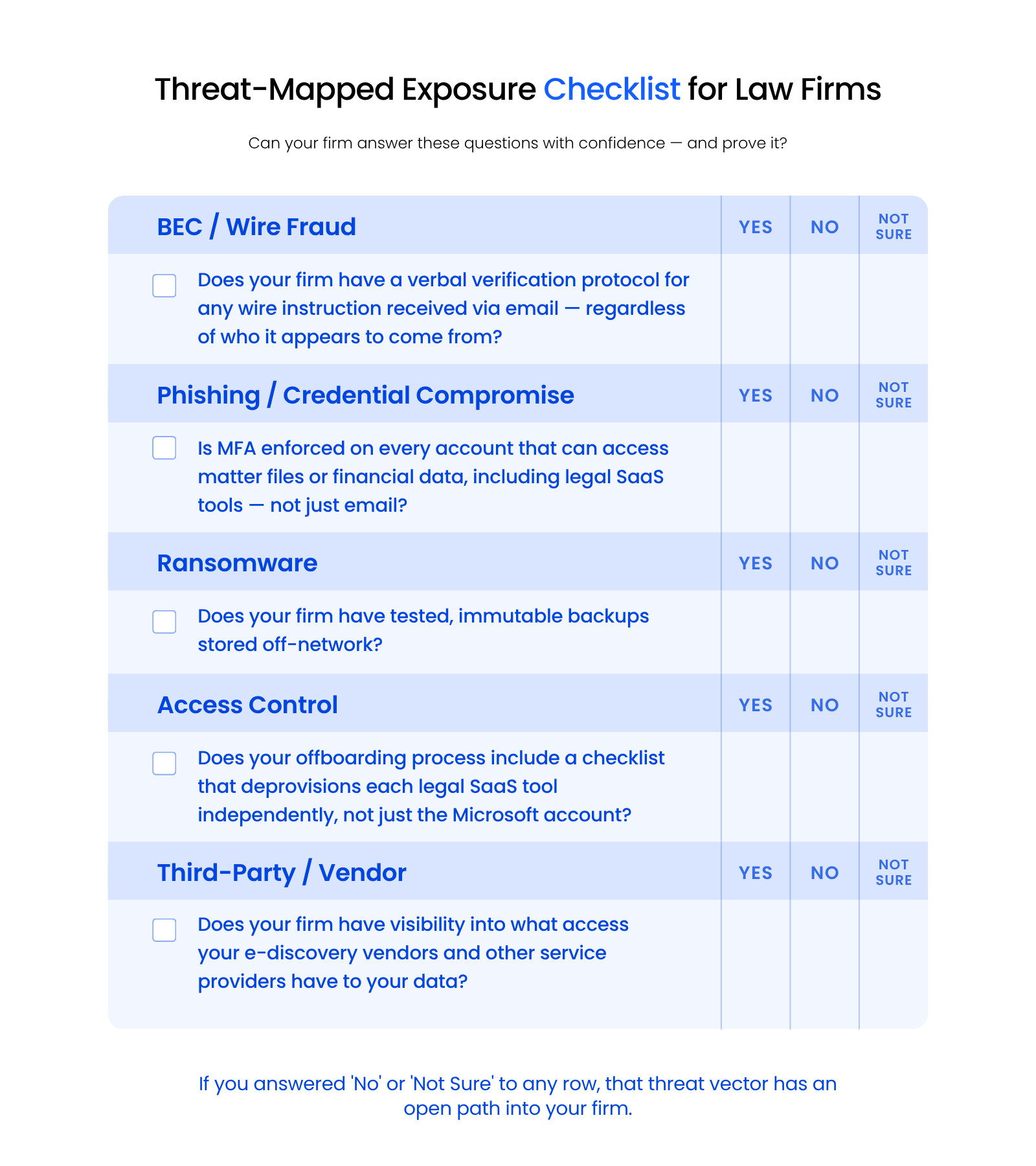
This isn’t a generic best-practices checklist — it’s a threat-mapped question: given what each attack actually exploits, what gap would it find at your firm?
BEC / Wire Fraud: Does your firm have a verbal verification protocol for any wire instruction received by email, regardless of who it appears to come from?
Phishing / Credential Compromise: Is MFA enforced on every account that can access matter files or financial data — including legal SaaS tools, not just email?
Ransomware: Does your firm have tested, immutable backups stored off-network? “We use Microsoft 365” isn’t a backup strategy — Microsoft’s own guidance recommends third-party backup.
Access Control: Does your offboarding process include a checklist that deprovisions each legal SaaS tool independently, not just the Microsoft account?
Vendor / Third-Party: Does your firm have visibility into what access your e-discovery vendors and other service providers have to your data?
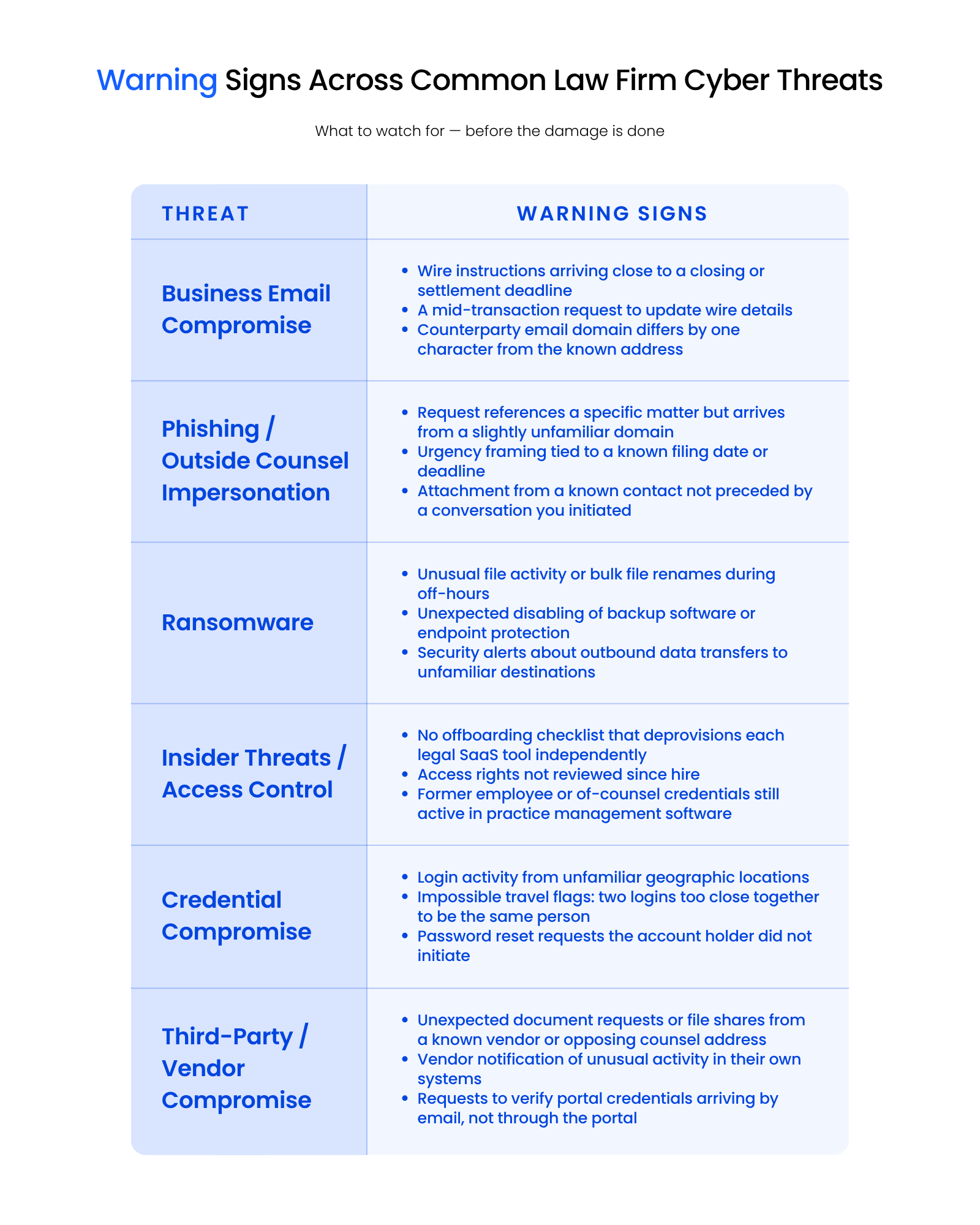
These aren’t hypothetical risks — they’re the specific mechanics that attackers use against law firms every day.
Uptime Legal works with law firms to close these gaps — MFA enforcement, ITDR, conditional access management, access audits, and tested backup strategies built around how legal environments actually operate. If you’re not sure how your firm would answer the questions above, an IT assessment is a reasonable place to start.
WHAT’S NEXT
Frequently Asked Questions

Uptime Legal’s Technology Solutions
Cloud, software, IT, and document management built for today’s law firms.