Table of Contents
You’ve probably seen the questionnaire. A client sends it with an engagement letter, or your insurer attaches it to a renewal form. Twenty or thirty questions about your firm’s security practices, and you’re not sure how to answer half of them accurately.
That’s the moment most firms start thinking seriously about compliance. Not because of a regulatory change or an ethics seminar, but because someone handed them a form they couldn’t fill out with confidence.
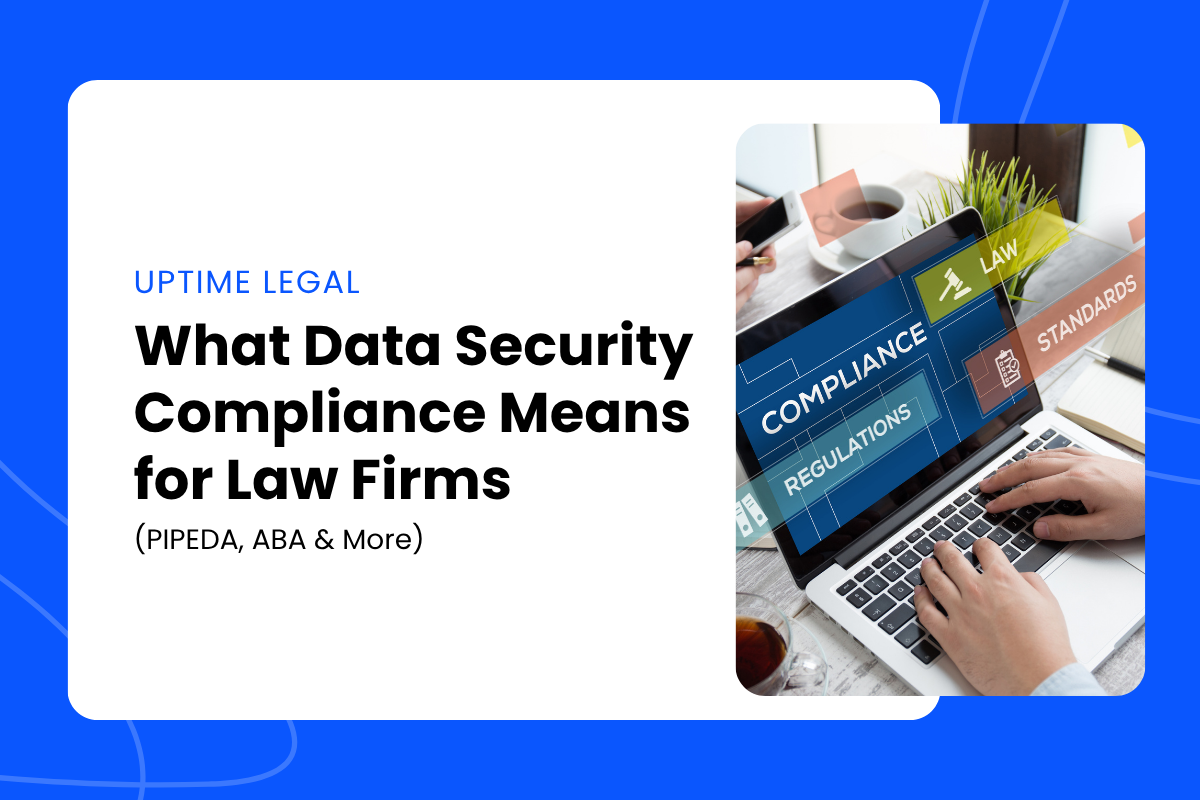
The challenge is that compliance for law firms isn’t one thing — it’s a stack of overlapping obligations from different sources: bar ethics rules, federal and provincial privacy regulations, client contract requirements, and insurer underwriting standards.
Most firms have never mapped all four layers together, which is exactly why those questionnaires feel so difficult and why cybersecurity for law firms has to be tied back to the firm’s real obligations. This article gives you that map.
Why Data Security Compliance Is Different for Law Firms
Most businesses deal with one or two regulatory frameworks. Your firm deals with at least four layers of compliance obligations, and they overlap in ways that aren’t always obvious.
The four layers:
No other type of business carries the professional ethics layer on top of everything else. A financial services firm has regulatory obligations. A healthcare provider has HIPAA.
Your firm has ethics rules plus regulations plus contractual requirements, and the consequences of falling short can include bar discipline, malpractice exposure, lost client relationships, and voided insurance claims.
The rest of this article maps each layer: what it requires, who it applies to, and what you’d need to document to demonstrate compliance.
Compliance Frameworks That Apply to Law Firms
| Framework | Who It Applies To | Key Requirements | What You Need To Document |
|---|---|---|---|
| ABA Model Rules | US lawyers, subject to state adoption and jurisdiction-specific rules | Reasonable efforts to protect client information and respond appropriately to incidents | Security policies, access controls, incident response plan, training records |
| State Bar Guidelines | Lawyers in states with applicable rules, comments, or ethics opinions | Technology competence, confidentiality, supervision, and secure handling of client data | State-specific guidance review, technology policies, training documentation |
| PIPEDA | Canadian firms and certain organizations with a real and substantial connection to Canada | Consent, safeguards, breach reporting, and breach recordkeeping | Privacy policies, safeguard documentation, breach log, notification process |
| HIPAA | Law firms acting as Business Associates for covered entities | BAA requirements, HIPAA safeguards, and breach notification duties | BAAs, PHI handling procedures, access controls, incident records |
| Client Contracts | Firms with outside counsel guidelines, vendor terms, or client security requirements | Contract-specific controls, reporting timelines, insurance requirements, and audit obligations | Client requirement matrix, control mapping, questionnaire responses |
| Cyber Insurance | Firms applying for or renewing cyber insurance | MFA, backups, endpoint protection, incident response, and accurate questionnaire answers | Renewal responses, control evidence, backup verification, security reports |
ABA Model Rule 1.6(c): The Ethical Foundation
For US law firms, the ethical foundation usually starts with confidentiality. ABA Model Rule 1.6(c) requires lawyers to make “reasonable efforts to prevent the inadvertent or unauthorized disclosure of, or unauthorized access to, information relating to the representation of a client.”
State rules and ethics opinions control in each jurisdiction, but the ABA language is still a useful baseline for understanding how cybersecurity connects to professional responsibility.
ABA Formal Opinion 483 extended this further in 2018, clarifying that lawyers must also monitor for unauthorized access to client data and notify affected clients after a breach. The obligation isn’t just prevention; it includes detection and response.
What “Reasonable Efforts” Looks Like in 2026
The Model Rules don’t prescribe specific technologies. But the standard for what qualifies as “reasonable” has evolved, and bar associations have been clear about the baseline they expect. In practical terms, that now includes:
These aren’t best-practice suggestions you can defer until next year — they’re the framework bar associations use when evaluating whether your firm met its obligations after something goes wrong. A firm that can’t document its security practices faces exposure in a disciplinary proceeding regardless of whether a breach has actually occurred.
In rare cases, the consequences go further. Attorneys have been disbarred for repeated inadequate technology practices when privileged information was compromised. It’s uncommon, but it confirms that the professional stakes are real.
State Bar Guidelines Beyond the ABA Baseline
Many states have issued formal cybersecurity guidance that goes beyond the ABA Model Rules. California, New York, Florida, and several others have published ethics opinions reinforcing that the duty of confidentiality extends to how client data is stored, secured, and transmitted digitally.
As of 2026, 42 states have adopted ABA Model Rule 1.1 Comment 8 or an equivalent provision, making technology competence an enforceable ethical standard in nearly every jurisdiction.
Your state bar may have stricter obligations than the ABA baseline. Check your jurisdiction’s formal opinions before assuming the ABA floor is your ceiling.
This article provides general information about compliance frameworks, not legal or compliance advice. Consult your state bar or a privacy attorney for firm-specific guidance.
PIPEDA: What Canadian Law Firms Need to Know
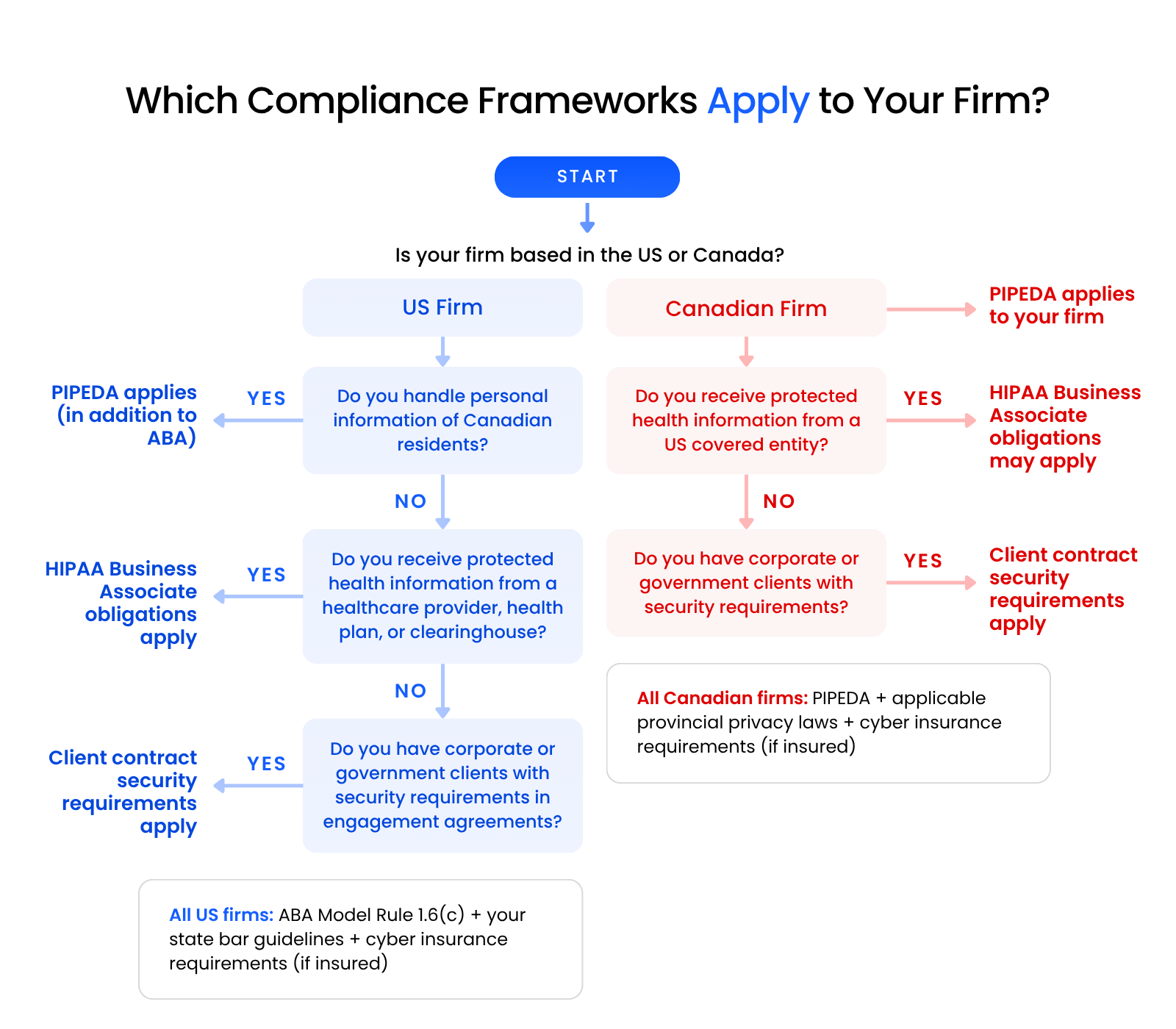
If your firm is based in Canada, or if you’re a US firm handling personal information of Canadian residents, PIPEDA applies to you.
The Personal Information Protection and Electronic Documents Act governs how organizations collect, use, and disclose personal information in the course of commercial activity. It doesn’t require your firm to be Canadian; it follows the data subject. A US firm representing a Canadian client in a cross-border transaction has PIPEDA obligations whether or not anyone at the firm has thought about it.
PIPEDA’s core requirements for law firms come down to three areas:
The breach notification obligation is more specific than the ABA’s guidance. Under PIPEDA, you’re evaluating whether the breach meets a defined harm threshold (the “real risk of significant harm” standard), and you’re reporting to a federal regulator, not just your state bar. The OPC has enforcement authority and has investigated organizations for inadequate notification practices.
Most US-based legal IT content ignores PIPEDA entirely. If you serve Canadian clients or operate in Canada, that gap leaves you without the guidance you actually need.
PIPEDA requirements are summarized here for general awareness. Consult a privacy attorney for firm-specific guidance, particularly for cross-border matters.
HIPAA: When It Applies to Law Firms (and When It Doesn’t)
Most law firms aren’t HIPAA covered entities. This is worth stating directly, because a lot of vendor content implies otherwise.
HIPAA applies to your firm only when you qualify as a Business Associate: an organization that receives protected health information (PHI) from a covered entity (a healthcare provider, health plan, or healthcare clearinghouse) in the course of providing services. The most common examples are firms handling personal injury, workers’ compensation, or medical malpractice cases where PHI is transmitted as part of the legal representation.
Representing a hospital doesn’t automatically make you a Business Associate — the determining factor is whether your firm receives, creates, maintains, or transmits PHI on behalf of the covered entity.
When HIPAA applies, here’s what it requires:
When HIPAA doesn’t apply: If your firm doesn’t receive PHI from a covered entity, HIPAA isn’t your obligation. General client confidentiality, trust account data, and corporate legal records are covered by ABA rules, state law, and client contracts, not HIPAA.
Being honest about this distinction builds credibility. Overstating HIPAA’s applicability to sell compliance services is a pattern in the market; knowing when it applies to your specific practice is more useful than assuming it applies to everyone.
Client Contract Data Security Requirements
This is the compliance layer most firms don’t think about systematically.
Corporate clients and government agencies are increasingly including specific data security requirements in engagement letters, outside counsel guidelines, and vendor agreements. These contractual obligations vary by client, but they often exceed what any single regulatory framework requires.
Common requirements include:
The challenge is scale. If you have 15 corporate clients with different security requirements, you need a baseline that meets all of them. Most firms agree to these terms during onboarding and then hope they’re in compliance, which works until someone checks.
That warning applies to insurer questionnaires too. If something catastrophic happens and you file a claim, the insurer investigates. If the information you provided to get the policy was inaccurate, it can void your claim entirely.
The questionnaire isn’t just a box to check; it’s a binding representation that your firm needs to answer accurately.
Breach Notification: Know Your Obligations Before You Need Them
Every framework covered in this article has its own breach notification requirements, and they differ in ways that matter during a crisis.
ABA Formal Opinion 483 says lawyers must make reasonable efforts to monitor for unauthorized access and notify clients when a breach occurs. The guidance is principles-based; it doesn’t prescribe specific timelines.
PIPEDA requires reporting to the OPC and notifying affected individuals “as soon as feasible” when a breach creates a “real risk of significant harm.” Breach records must be maintained for at least 24 months.
US state breach notification laws vary significantly. Notification timelines range from 30 to 90 days depending on the state, and some states require notification to the state attorney general in addition to affected individuals.
Client contracts often impose tighter timelines than any regulatory framework, sometimes as short as 24 hours.
The practical takeaway: document your notification obligations for each applicable framework now, while you can think clearly. Figuring out who you need to notify, within what timeframes, and under which frameworks isn’t something you want to work through during an active incident.
Law Firm NIST Compliance and Cyber Insurance
For a deeper look at what insurers check during underwriting and how to prepare for a renewal.
How a Legal IT Partner Supports Compliance Documentation
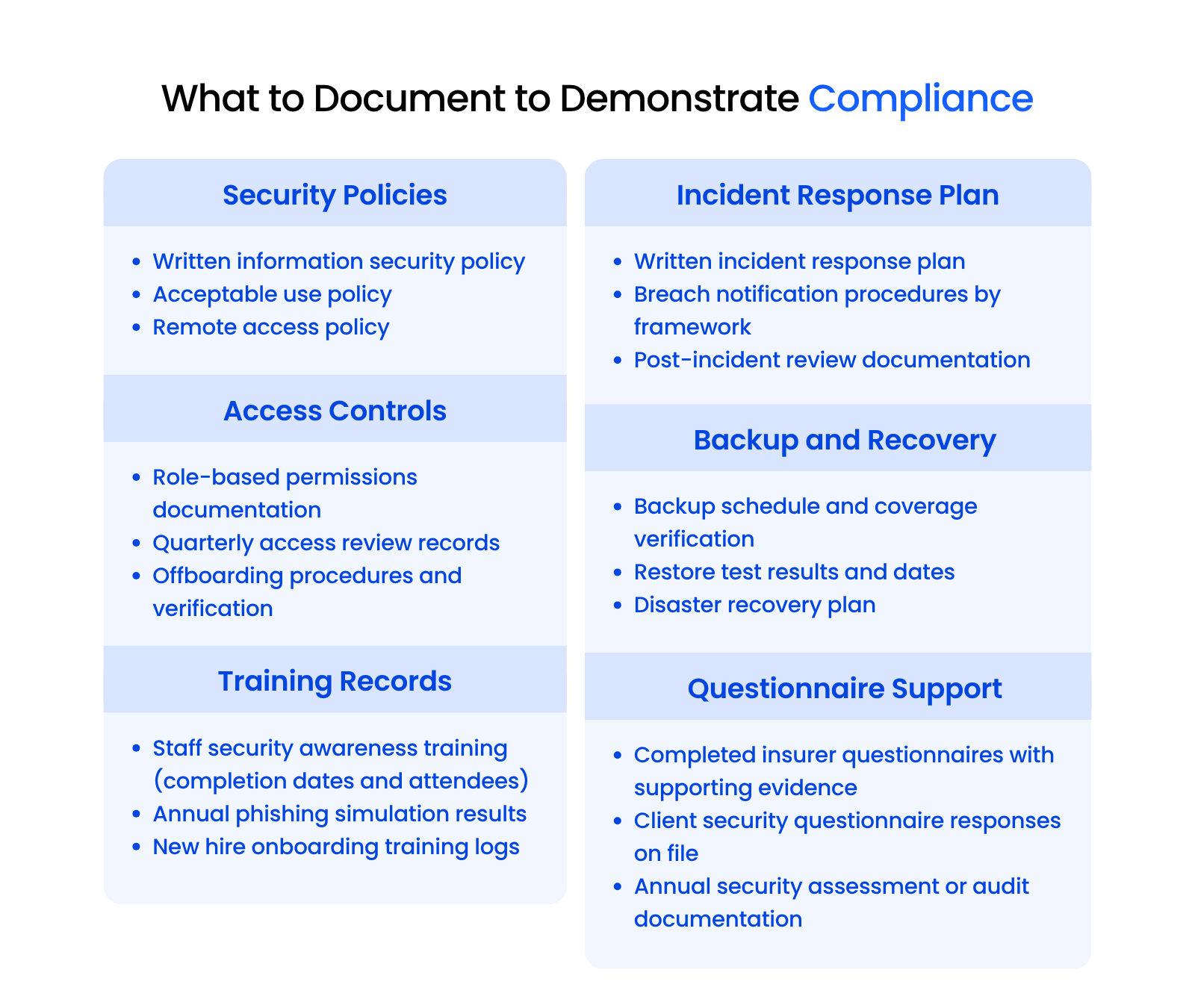
Compliance across all of these frameworks has one thing in common: documentation.
Policies need to be written. Controls need to be recorded. Training needs to be logged.
Questionnaires need to be answered accurately by someone who understands what the questions are actually asking.
Most firms don’t maintain this documentation internally, and it shows when a client questionnaire, insurer renewal, or bar inquiry surfaces gaps the firm assumed didn’t exist.
A legal-specific managed IT partner handles the documentation layer that supports compliance claims across frameworks:
Uptime Manage supports law firms with exactly this kind of compliance infrastructure: documented controls, maintained policies, and support answering the questionnaires that increasingly drive compliance behavior. The value isn’t in checking boxes — it’s in giving your firm defensible, accurate answers backed by the practices to support them.
Your Compliance Map Starts with Knowing What Applies
Most firms don’t fail at compliance because they refuse to take it seriously — they fail because they’ve never mapped out which obligations actually apply to their practice, what those obligations require, and what documentation they’d need to produce if someone asked.
Now you have that map. The next step is assessing where your firm actually stands, and whether the answers you’ve been giving on questionnaires match the practices behind them.
WHAT’S NEXT
Frequently Asked Questions

Uptime Legal’s Technology Solutions
Cloud, software, IT, and document management built for today’s law firms.