Table of Contents
Your lawyers already use AI, whether it’s Copilot, ChatGPT or the AI features in your practice tools. Your partners have read about ABA Opinion 512. What stalls the decision is whether the state bar AI ethics opinions your lawyers answer to say something different.
Firms we talk to describe the same stall: someone tried Copilot and hit its limits, the partners disagree on how far to go, and nobody will write a policy until they know what their own bar expects.
Most of what those opinions add to Opinion 512 concerns your firm’s tools, vendor contracts and records, which makes it part of deciding how your firm uses AI.
We’ve organized this by issue instead of by state, because the changes you’ll make cut across states. Each issue compares the ten opinions we read in full and ends in what to change in your setup, drawn from the IT and security work we do for law firms.
Do State Bar AI Ethics Opinions Override ABA Opinion 512?
Your state’s rules of professional conduct govern your lawyers, so where your state bar has issued AI guidance on those rules, that’s the guidance they answer to. ABA Opinion 512 is persuasive, and most state opinions build on it.
Both kinds are advisory. Florida Bar Ethics Opinion 24-1 says so: “Advisory ethics opinions are not binding.”
Size doesn’t exempt your firm: Alabama State Bar Formal Opinion 2026-01 says its guidance applies equally to solo practitioners, small firms and large firms.
So the first question is which opinions apply to your lawyers.
Which State AI Opinions This Article Covers
This article compares ten opinions, each read in full, against Opinion 512:
California’s document is guidance rather than an opinion, and the NYC Bar is a city bar association, not New York State’s. Published counts of states with AI guidance disagree, so this article sticks to opinions it could read in full.
What If Your Firm Practices in More Than One State?
Check the guidance in every jurisdiction where your lawyers are licensed. California’s 2026 guidance has a Rule 8.5 section telling attorneys to understand the rules of each jurisdiction where they’re licensed.
That matters most where two states split: a firm with lawyers in Florida and North Carolina gets two different answers on self-hosted AI (AI run on your firm’s own servers or systems). Which state’s rule governs a particular matter is a question for ethics counsel.
Where Do State AI Opinions Go Further Than Opinion 512?
State AI opinions go further than Opinion 512 in four places:
None of them approves or names compliant AI tools. Alabama’s opinion puts that job on your firm: “Centralize approval of AI tools used firm-wide.”
The two tables below compare them issue by issue, with 512 as the baseline row. A dash means we found nothing in that opinion that goes further than 512 on that issue.
How the 2024 and 2025 Opinions Compare with 512
The 2024 and 2025 opinions mostly apply the duties 512 does, and differ from it chiefly on consent and on in-house AI.
How the 2026 Guidance Compares with 512
Measured against the same 512 baseline, the 2026 guidance goes furthest, and nearly every addition attaches to a specific tool.
Alabama’s opinion says AI “does not create new ethical duties for lawyers,” and the 2026 additions apply existing duties to tools that read email, answer prospective clients and record calls.
On fees, the opinions we read mostly track 512; California adds that general-purpose AI subscriptions are typically overhead, and that matter-specific AI costs can be billed at actual cost when the fee agreement discloses them.

When Does Your State Require Client Consent Before Using AI?
West Virginia’s Legal Ethics Opinion 24-01 says a lawyer should obtain informed client approval before using generative AI, confirmed in writing, while Texas Opinion 705 says only that a lawyer may need consent. The opinions in between each tie consent to a different trigger, so a one-line “get client consent” policy matches none of them.
How Consent Triggers Run from West Virginia to Texas
State bars don’t agree on when AI use needs client consent: West Virginia says to get written approval before using generative AI, and Texas leaves it to case-by-case judgment.
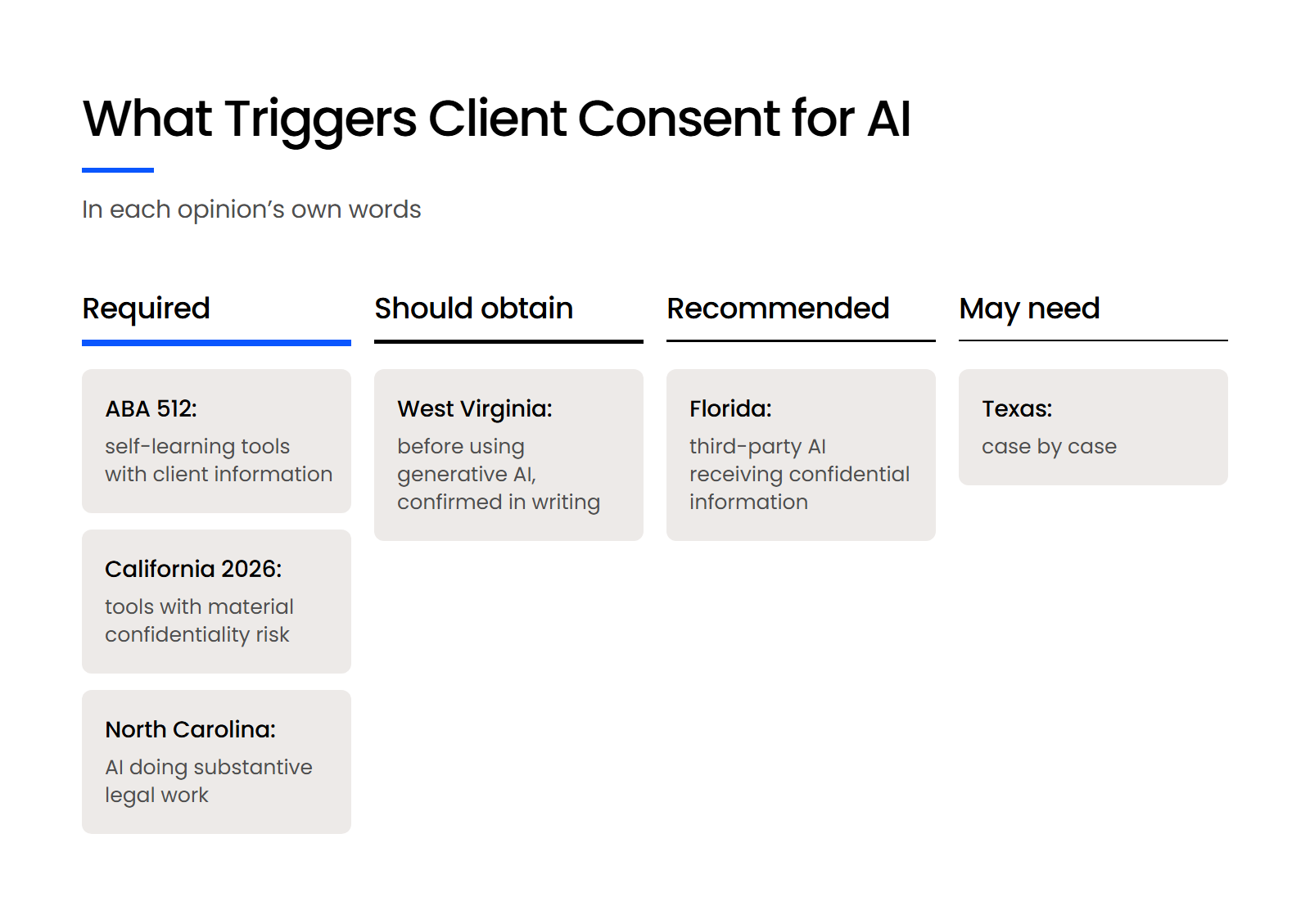
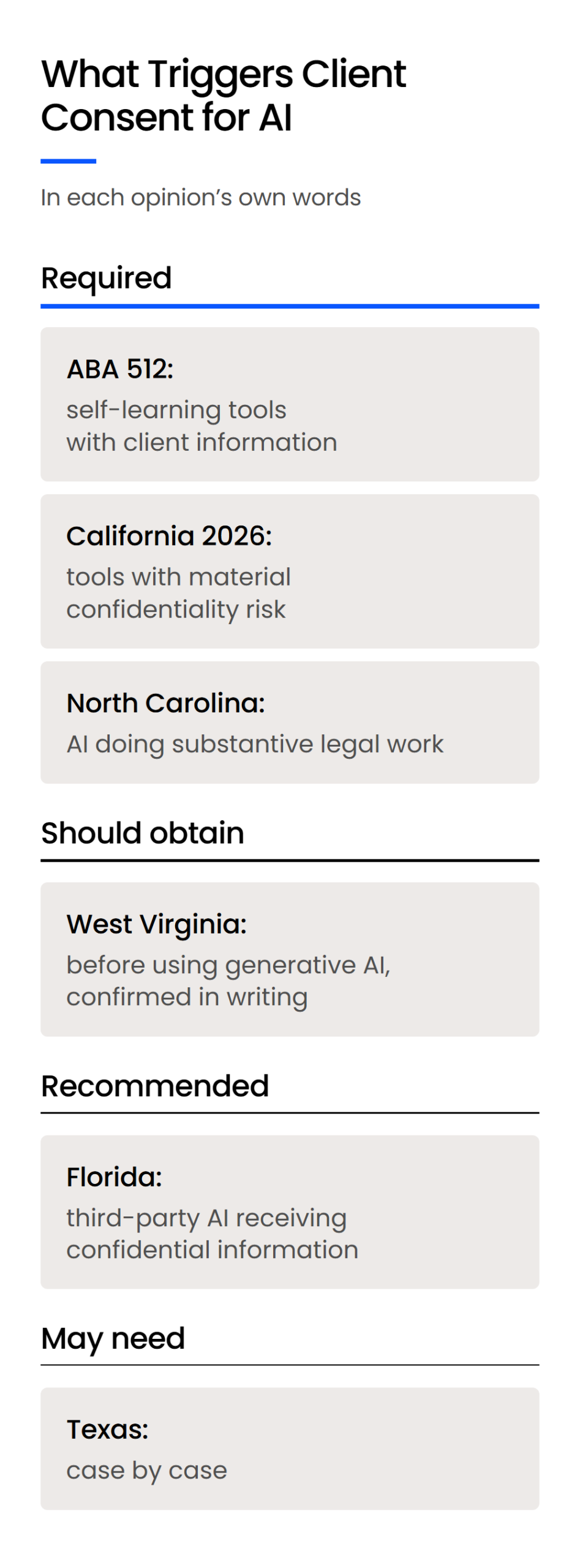
West Virginia’s opinion sits at the strict end: “A lawyer should obtain approval from the client before using generative AI, and this consent must be informed and should be confirmed in writing.”
Florida’s opinion says “it is recommended that a lawyer obtain the affected client’s informed consent prior to utilizing a third-party generative AI program if the utilization would involve the disclosure of any confidential information.” So Florida only recommends consent, and only for third-party programs that would receive confidential information.
California’s 2026 guidance bars putting confidential information into a generative AI tool that may present material risks to confidentiality or security, absent informed client consent. North Carolina ties consent to substantive tasks delegated to AI, not ordinary research or practice management.
Texas places itself below the ABA and Florida: “Ethics opinions from the ABA and the Florida Bar go a step further and suggest that lawyers should obtain informed consent before using these tools.” Alabama asks lawyers to document consent where disclosure risks remain, and Opinion 512’s self-learning-tool trigger sits between West Virginia and Texas.
What Changes in Your Intake and Engagement Process
The change is procedural: decide where consent is captured in your engagement letter and intake workflow, and keep a record someone can find later. Opinion 512 already says boilerplate engagement-letter language isn’t enough.
A usable consent record has three parts:
If your lawyers are licensed in several states, decide which trigger your process follows and check that choice with ethics counsel.
Vendor Terms, Data Training and Where the AI Runs: What States Add
Several state opinions extend Opinion 512’s vendor review: Oregon reaches the vendors a product is built on, Texas contemplates renegotiating terms of service, DC names zero data retention, and Florida and North Carolina disagree on whether running AI in-house changes the duty.
Does Running AI in Your Own Tenant or on Your Own Servers Change Anything?
The states disagree. Florida’s opinion says “confidentiality concerns may be mitigated by use of an inhouse generative AI rather than an outside generative AI,” and that consent isn’t required under its Rule 4-1.6 when no confidential information goes to a third party.
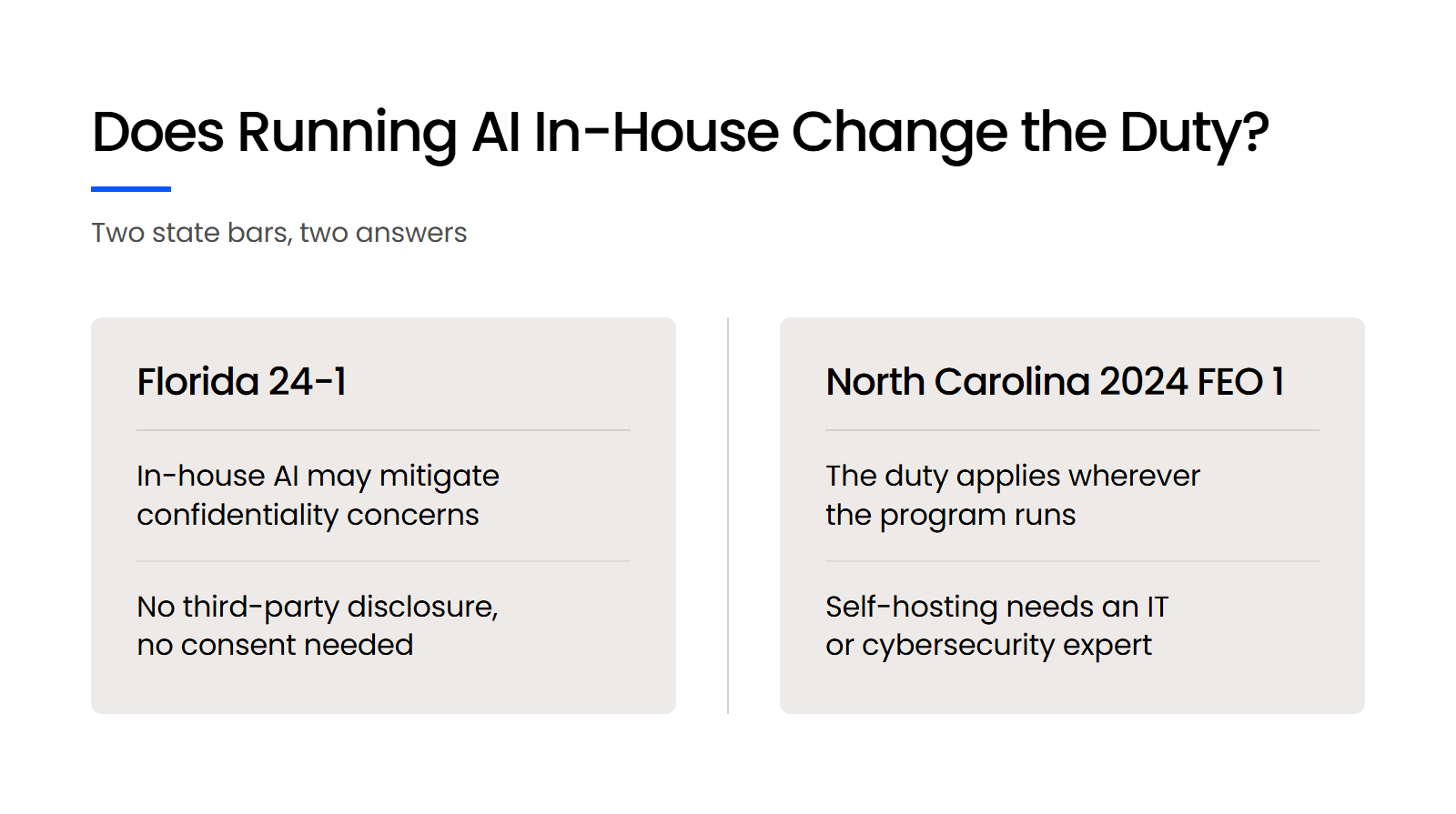
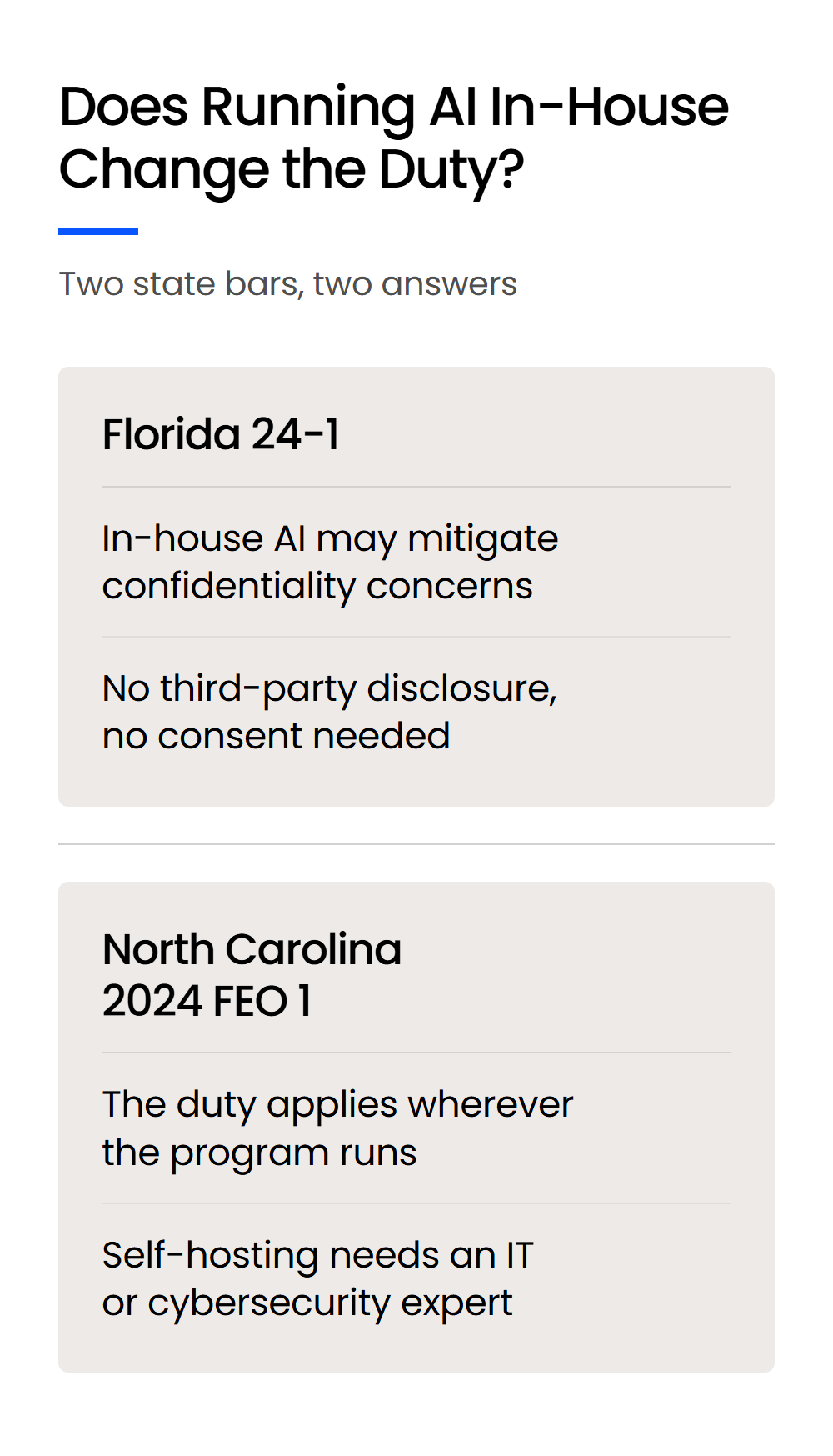
Florida and North Carolina disagree on whether running AI in-house changes your confidentiality duty, so check your own state’s answer before relying on self-hosted AI. North Carolina’s side:
North Carolina also says a lawyer who plans to store client information independently should consult an IT or cybersecurity expert.
Starting with Microsoft Copilot inside your firm’s own Microsoft 365 tenant (your firm’s private instance of Microsoft 365) is a lower-risk first step than starting with a consumer AI account, because the work stays inside the suite your firm already runs.
In North Carolina, the duty is the same either way. Under Microsoft’s enterprise data protection, prompts and responses from your firm’s accounts aren’t used to train foundation models and fall under Microsoft’s data protection terms with your firm, so make sure lawyers sign in with the firm’s account.
What States Add to the Vendor Review
Opinion 512 already asks you to understand a tool’s terms and data use.
Oregon’s opinion pushes the review down the supply chain: “In computer software, a software product may rely at least in part on software products from other vendors.” Its diligence reaches those underlying vendors and application programming interfaces (APIs), and asks you to confirm client data stays out of training and separate between clients.
The other opinions add contract points:
Alabama notes that free consumer versions “generally do not include such protections,” so its “enterprise or closed systems whenever possible” is the line to act on first: turn off consumer AI accounts for client work.
Can an AI Tool Carry One Client’s Information into Another Matter?
Pennsylvania and Philadelphia’s Joint Formal Opinion 2024-200 says it can. Some generative AI models lack safeguards like ethical walls, and the opinion warns that “they may run afoul of Rules 1.7 and 1.9 by using the information developed from one representation to inform another.”
It’s the only opinion read that raises cross-matter conflicts, so ask every AI vendor how its tool keeps one matter’s information out of another’s.
Do You Have to Keep Records of AI Use?
Alabama Formal Opinion 2026-01 tells lawyers to document AI use in client matters and to cover AI interaction logs in a firm-wide retention policy, and DC Opinion 388 asks whether AI interactions belong in the client file. Neither sets a retention period.
Alabama’s wording is direct: “Document your AI use in client matters.” It also says to “Establish firm-wide document-retention policies that address AI interaction logs and AI-generated drafts.” Each record covers the tool, date, task, output and verification.
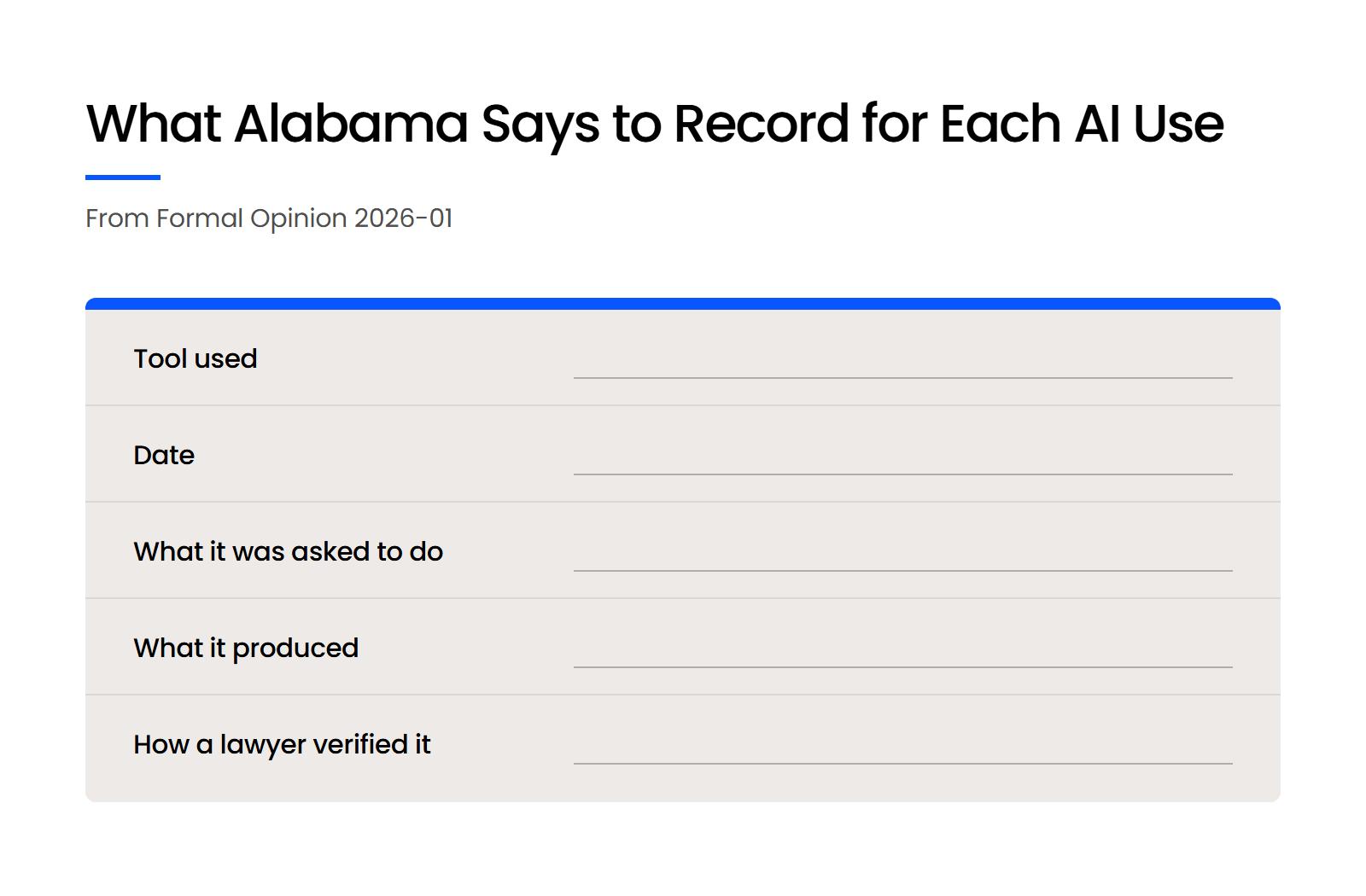
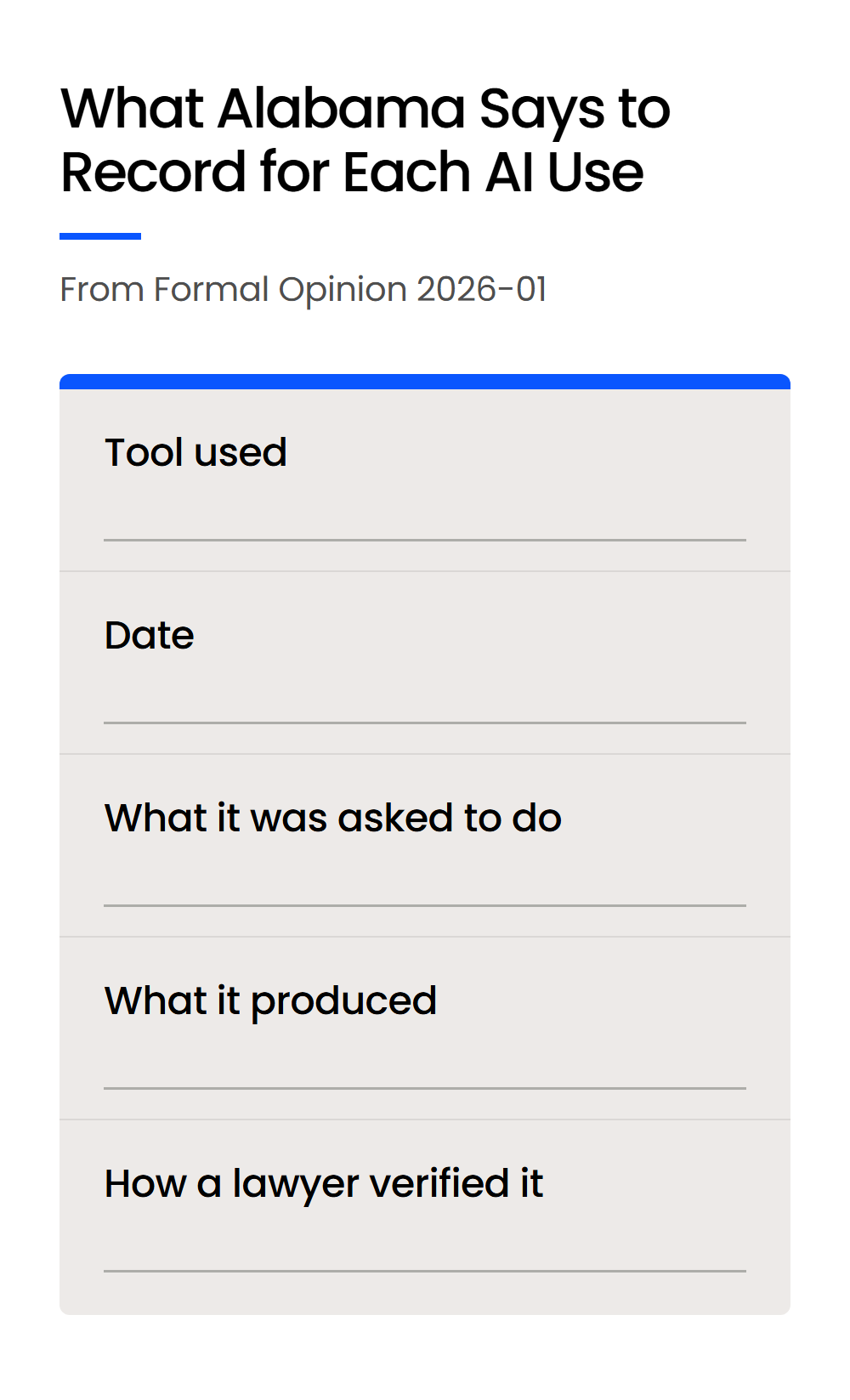
DC’s opinion adds that “a lawyer should consider whether specific interactions with GAI in connection with a client matter should be retained as part of the client file.” How long to keep any of it is your firm’s call, made alongside your existing retention schedule.
In practice, that comes down to three settings:
Decide these before an AI tool touches client matters; a log that was never kept can’t be produced later.
What Does 2026 Guidance Say About AI Agents, Chatbots and Meeting Recorders?
The 2026 guidance adds duties tied to specific tools: California tells attorneys to limit what AI agents can reach, Alabama says to audit agent activity logs, Oregon sets conditions for website chatbots, and the NYC Bar treats knowing how to turn off AI recording as part of competence.
How California and Alabama Limit AI Agents That Reach Email and Documents
No opinion read forbids connecting an AI agent to email or document management, and California’s 2026 guidance sets the condition: “Attorneys must carefully evaluate and limit the scope of such access.” The reach that makes Copilot useful, seeing Outlook and your file system, is the reach California tells attorneys to scope.
California adds three limits:
It also says “reasonable efforts may include consulting with qualified IT professionals or cybersecurity experts.” Alabama says to “Audit AAI activity logs regularly” (AAI is its term for agentic AI) and to document a human review before an agent acts.
An agent that operates a computer on its own can send client information out of the firm with no one reviewing it first, so keep a person approving anything that leaves the firm. The controls to require of an AI agent turn California’s scope rule into specific settings.
What Oregon and Florida Expect of Website Chatbots and AI Intake
Oregon’s opinion asks you to confirm that a website chatbot or AI intake agent doesn’t use client information for training and keeps each client’s information separate from other clients’. Its diligence runs down the vendor chain, and it says “it would be prudent to have a responsible lawyer be automatically notified” whenever the chatbot interacts with a prospective client.
Florida’s opinion adds that “a lawyer must inform prospective clients that they are communicating with an AI program and not with a lawyer or law firm employee.” If your website runs a chatbot, check four settings: training, isolation, lawyer notification and the disclosure line.
When the NYC Bar Says Not to Use AI Recording or Transcription
NYC Bar Formal Opinion 2026-2 says “The duty of competence includes knowing how to turn off the recording function, so that conversations are not inadvertently recorded.” For conversations with non-clients, such as opposing counsel or witnesses, its default is not to use AI to record, transcribe or summarize them absent a good reason in the particular case.
So if someone asks whether Teams or Zoom AI can record a call with opposing counsel, the opinion’s default answer is no. Account settings that keep uninvited AI notetakers out of your meetings are where that default gets set.
State-by-State Quick Reference: What Each Opinion Adds to 512
If you arrived for one state, here’s what each opinion adds beyond Opinion 512.
Each row is a summary, so read your own state’s opinion in full before you change a policy.
What to Change in Your Firm’s Setup, and What to Ask Ethics Counsel
A firm already set up to Opinion 512 has a short, specific list of changes for its own state, and most of them are settings, vendor terms and records.
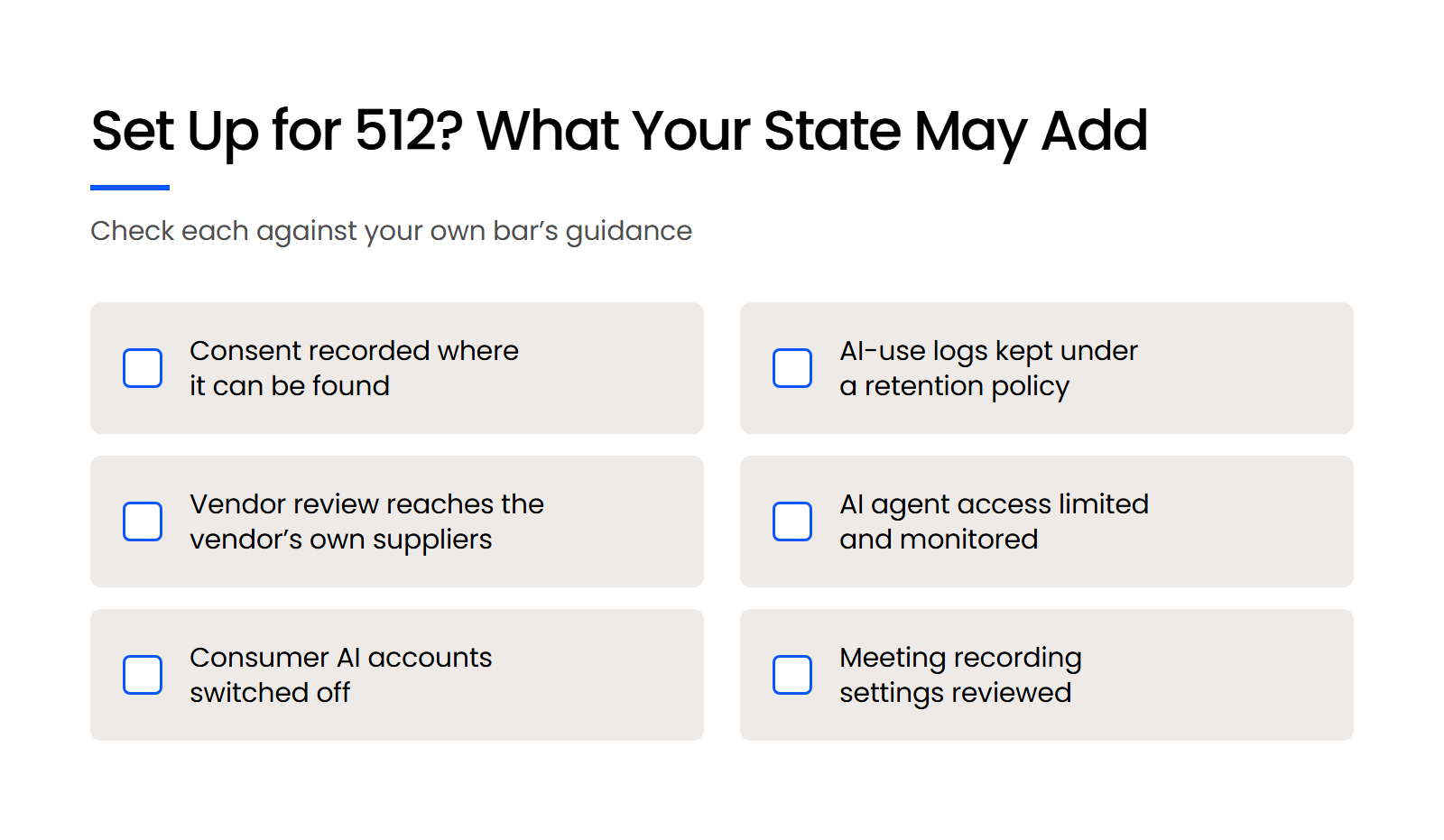
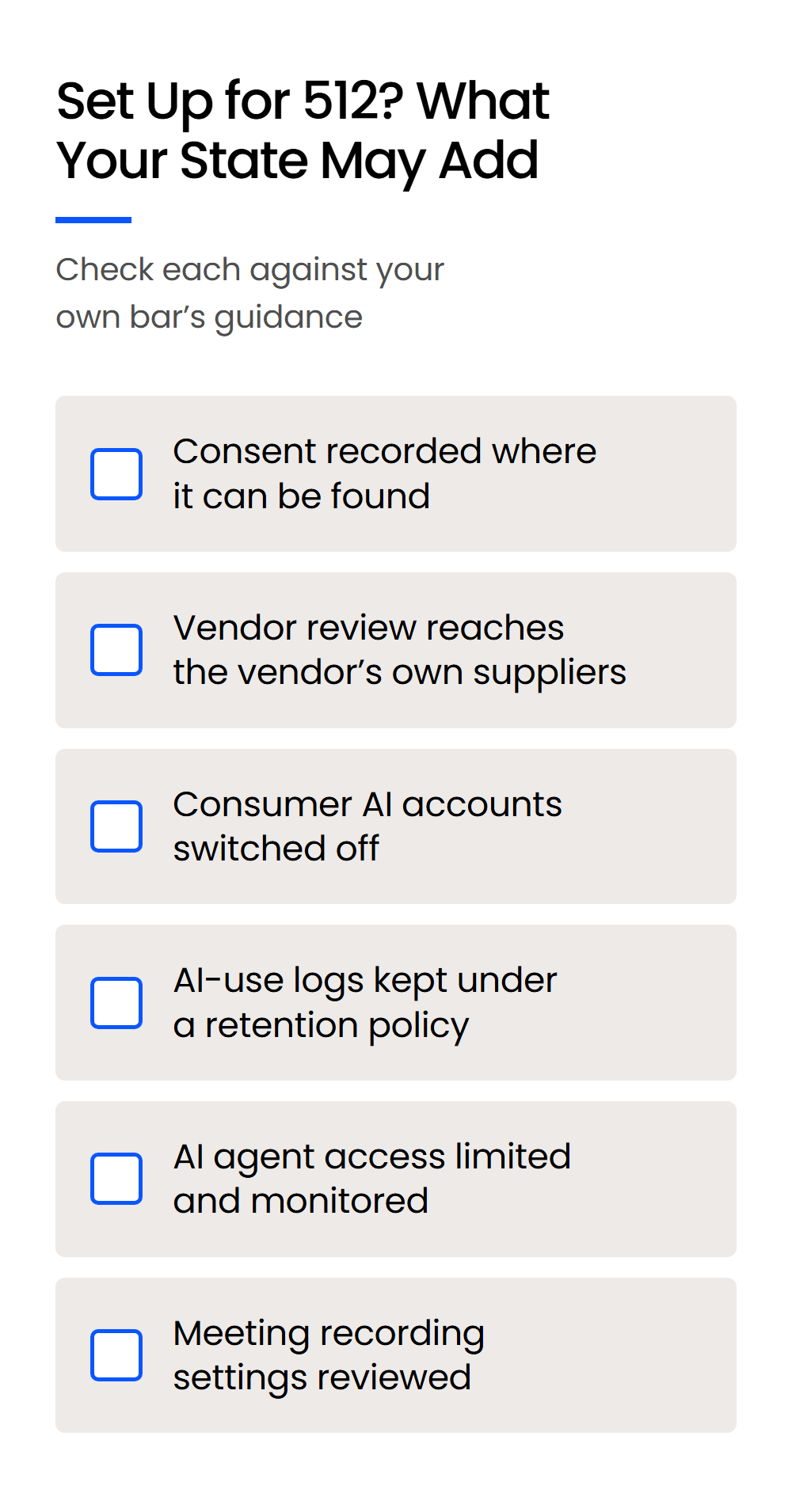
Whether a specific use of AI on a specific matter is permitted in your state is a question for ethics counsel or your state bar’s ethics hotline. An IT provider can configure, scope and document your tools to match counsel’s answer.
WHAT’S NEXT
FAQ

Uptime Legal’s Technology Solutions
Cloud, software, IT, and document management built for today’s law firms.