
Pick the wrong practice management software and every part of your firm feels it. Billing gets messy, documents scatter across three different logins, and staff quietly build workarounds instead of using the system you paid for.

The right law practice management software depends on your firm’s size and workflow, but there’s a second decision that matters just as much as which vendor you pick: whether that software runs on your own server or in the cloud.

This guide breaks down 15 practice management platforms, from PCLaw to Clio, and where each one actually fits. It also covers a question most buying guides skip: how server-based and cloud-based deployment change what you get, and why that choice deserves its own line on your checklist.

What Is Law Practice Management Software?

Law practice management software is a system that centralizes case management, billing, and documents so your firm runs on one connected platform instead of scattered tools.

We work with hundreds of law firms across North America, and the question we hear most often is some version of “what’s the best law practice management software?” That’s a bit like asking what the best kind of car is. The answer depends on what your firm actually needs.

Some practice management platforms lean heavily on accounting. If your firm already has accounting software it’s committed to, that focus doesn’t help you. Other platforms lean into document and form creation, which matters for some firms and not others.

Start by identifying which features and functions matter most to your firm. That list becomes the framework you hold every option against, and it’s a faster path to a shortlist than reading every review on the internet.

Whatever practice management tool sits at the center of your firm is really the epicenter of its heartbeat, if it’s not working, the firm’s not working.

— Dennis Dimka, Founder, LexWorkplace

What Does Law Practice Management Software Actually Do?

A law practice management platform needs to handle four jobs well, no matter which one you choose: case and client management, financial and trust accounting, documents and communication, and access and integrations.

The scope and depth of any given platform varies quite a bit from product to product. Here’s what to expect across the four core categories.
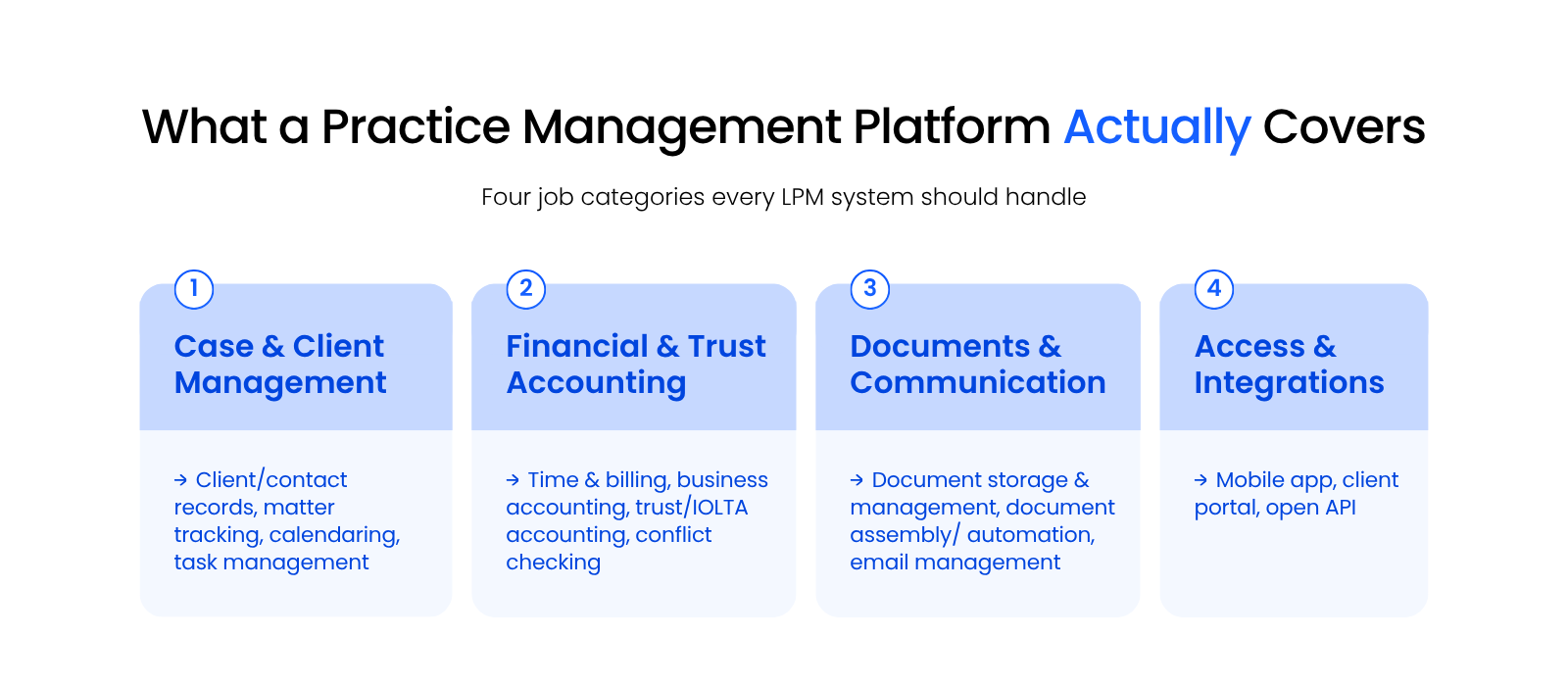
Four-quadrant graphic grouping law practice management software features into case management, financial, documents, and access categories.

Case and Client Management

Case and client management keeps every matter’s contacts, deadlines, and tasks in one searchable record instead of scattered notes. This category covers your client and contact database, matter tracking, calendaring, task management, and conflict checking, which matters for a law firm specifically because you need a documented record every time you check for a conflict of interest.

Financial and Trust Accounting

Billing, business accounting, and trust or IOLTA accounting live together so your firm invoices accurately and stays compliant with trust-fund rules. Trust accounting in particular is not optional for a law firm the way it would be for most small businesses. Your platform needs to track client funds separately and produce the reporting your bar requires.

Documents and Communication

Document storage, assembly, and email management keep case files and client correspondence attached to the right matter automatically. Document assembly automates the preparation of court documents and forms, and email management saves messages to the right matter through Outlook integration instead of leaving them buried in someone’s inbox.

Access and Integrations

Mobile access, a client portal, and an open API let your team and your clients reach the system from anywhere without extra software. A client portal in particular gives clients a way to see updates and share documents without a phone call, which cuts down on routine status-check emails.

The Best Law Practice Management Software at a Glance

The fastest way to narrow 15 practice management platforms down to a shortlist is to compare them side by side on deployment, price, and firm size.

In our experience working with hundreds of law firms, here’s how the top law practice management platforms stack up. We’ve grouped them by deployment method first, because that choice shapes everything else about how the software runs.

The Best Law Practice Management Software at a Glance

Software Deployment Starting Price Best For
PCLaw Server-based or private cloud Contact vendor Firms wanting billing and accounting unified in one system
Tabs3 and PracticeMaster Server-based or private cloud Contact vendor Firms needing strong back-office billing plus matter management
ProLaw Server-based or private cloud Contact vendor Firms wanting case management, document management, and accounting together
Time Matters Server-based or private cloud Contact vendor Firms that want deep customization of workflows and reports
Clio Cloud-based $49/user/month Solo and small firms wanting quick setup and broad integrations
Actionstep Cloud-based Contact vendor Midsize firms wanting an end-to-end platform with full legal accounting
Smokeball Cloud-based Contact vendor Firms wanting automatic time capture and heavy document automation
LEAP Hybrid (cloud with desktop app) Contact vendor Form-heavy practices needing jurisdiction-specific document assembly
CosmoLex Cloud-based $109/user/month Firms wanting built-in business and trust accounting without QuickBooks
Rocket Matter Cloud-based $49/user/month Firms that want visual, project-style matter tracking
MyCase Cloud-based $39/user/month Firms prioritizing a strong client portal and fast onboarding
Practice Panther Cloud-based $49/user/month Solo and small firms wanting a lightweight built-in CRM
Bill4Time Cloud-based $27/user/month Firms with complex billing needs like LEDES or split arrangements
Centerbase Cloud-based Contact vendor Firms wanting a highly customizable all-in-one platform
LeanLaw Cloud-based $55/user/month Firms that want deep QuickBooks integration for billing

A private cloud hosts your law practice management software, documents, and data in the cloud so you get the reliability, security, and mobility of cloud computing without giving up the server-based software your firm already knows.

Move Your Legal Software to the Cloud

With Uptime Cloud:

  • Cloudify Your Legal Software
  • Expert Legal Software Hosting/Support
  • Cloud Storage for Documents + Data
  • End-to-End Security
  • Office 365 + IT Support (Optional)

Server-Based and Private Cloud Law Practice Management Software

PCLaw, Tabs3, ProLaw, and Time Matters give firms deep, mature functionality that runs on your own server or a private cloud instead of a vendor’s servers.

These four platforms have been around for decades, and that maturity shows up as depth: more configuration options, tighter accounting integration, and features that newer cloud-native tools haven’t built yet.


PCLaw

PCLaw pairs lightweight case and client management with strong built-in billing and business accounting, and it’s one of the few platforms on this list that doesn’t require separate bookkeeping software.

  • Fast to set up without hiring a consultant

  • Fully integrated business and trust accounting

  • Straightforward, uncomplicated case management

  • Tight integration with Time Matters

Pricing: Subscription-based, per-user. Contact the vendor for details.

Tabs3 and PracticeMaster

Tabs3 and its counterpart, PracticeMaster, work together as one suite: Tabs3 handles the “back office” (time, billing, and accounting), and PracticeMaster covers the “front office” (client and matter management).

  • Modular front-office and back-office design

  • Strong customer support reputation

  • Large network of authorized consultants

Pricing: Based on total users and timekeepers. See the vendor’s price calculator.

ProLaw

ProLaw is the only platform on this list built to run case management, document management, and accounting together in one system, which cuts down on the number of vendors your firm has to manage.

  • End-to-end solution across practice management, document management, and accounting

  • Deep integration with Microsoft Office

  • Modern, simplified interface

Pricing: Varies by firm. Starts at a 10-user package.

Time Matters

Time Matters pairs deep customization with strong document management, and firms often pair it with PCLaw or Juris for accounting.

  • Deep customization across reports, workflows, and dashboards

  • Large network of certified consultants

  • Tight integration with PCLaw for accounting

Pricing: Subscription-based, per-user. Contact the vendor for details.

You don’t have to give up PCLaw, Tabs3, ProLaw, or Time Matters to get cloud benefits. A private cloud runs any of them on secure infrastructure your firm never has to maintain, so you keep the software and gain the mobility.

Cloud-Based and Web-Based Law Practice Management Software

Clio, MyCase, CosmoLex, and eight other cloud-native platforms run entirely in the browser, trading some of the deep customization above for fast setup and low maintenance.

Clio

Clio Manage is among the most widely adopted cloud-based practice management platforms, known for its clean interface and deep integrations with tools firms already use.

Stand-out features:

  • Clean, modern interface that’s fast to learn

  • Deep integrations through the Clio App Directory

  • Clio Duo, a native AI assistant for case summaries and document analysis

  • Pairs with Clio Grow for intake and CRM

Pricing: EasyStart is $49/user/month, Essentials is $89/user/month, Advanced is $119/user/month, and Complete is $149/user/month (includes Clio Grow). Pricing is billed annually.

Actionstep

Actionstep is built for midsize firms that want intake, matter management, document management, billing, and full legal accounting on one configurable platform.

  • End-to-end platform from intake through legal accounting

  • Highly configurable workflows and data fields

  • Strong trust accounting and financial reporting

Pricing: Three tiers (Practice Pro, Practice Pro + Accounting, and Premier). Pricing isn’t published; contact the vendor directly.

Smokeball

Smokeball blends practice management with document automation and tight Microsoft and Outlook integration, and it markets itself well to firms of nearly any size.

  • AutoTime automatic time tracking captured directly in Word and Outlook

  • Large document assembly template library

  • Smokeball AI for drafting and summarization

Pricing: Four tiers (Bill, Boost, Grow, and Prosper+). Smokeball offers a 30-day free trial of its Boost plan; contact the vendor for current rates.

LEAP

LEAP is possibly the most capable of the cloud-connected platforms on this list, built around a comprehensive library of state and federal forms.

  • Sophisticated, jurisdiction-specific form and document assembly

  • Hybrid cloud-plus-desktop experience for responsiveness

  • Built-in trust and legal accounting

Pricing: Not published. Contact the vendor or a LEAP partner such as Uptime Legal.

CosmoLex

CosmoLex bundles practice management with full business and trust accounting, which means most firms don’t need a separate QuickBooks subscription.

  • Integrated business and trust accounting with no separate bookkeeping system

  • Financial-first matter views for balances and revenue

  • Built-in trust and IOLTA compliance tooling

Pricing: Standard is $109/user/month, Elite is $129/user/month, and the FirmsFirst Bundle is $223/user/month. Pricing is billed annually.

Rocket Matter

Rocket Matter takes a project-management approach to matter tracking, including kanban-style boards for visualizing case progress.

  • Project-style matter management with kanban views

  • Document assembly with auto-filed outputs and client sharing

  • Optional insurance defense module

Pricing: Essentials is $49/user/month, Pro is $79/user/month, Premier is $99/user/month, and Elite is $129/user/month. Pricing is billed annually.

MyCase

MyCase built its reputation on ease of use and arguably has the strongest client portal of any platform on this list.

  • Fast to get up and running

  • Sophisticated client portal for messaging, documents, and payments

  • Built-in lead and intake management

Pricing: Basic is $39/user/month, Pro is $89/user/month, and Advanced is $109/user/month. Pricing is billed annually.

Practice Panther

Practice Panther is a popular choice for solo and small firms that want an intuitive interface plus a lightweight CRM for intake.

  • Clean, intuitive interface

  • Built-in payment processing

  • Lightweight CRM for lead management

Pricing: Solo is $49/user/month, Essential is $69/user/month, and Business is $89/user/month. Pricing is billed annually.

Bill4Time

Bill4Time started as a time and billing tool and has grown into a full practice management platform, with billing flexibility as its core strength.

  • Flexible, compliant billing including LEDES and UTBMS codes

  • Trust accounting with IOLTA reconciliation

  • Support for split billing arrangements and detailed approvals

Pricing: Time & Billing is $27/user/month, Time & Billing Enterprise is $67/user/month, Legal Pro is $45/user/month, and Legal Enterprise is $80/user/month. Pricing is billed annually.

Centerbase

Centerbase is a highly customizable cloud platform built around native general-ledger accounting alongside matter, time, and billing.

  • End-to-end case management with native accounting

  • Deep configuration of matter types, fields, and automations

  • Reduces vendor sprawl for firms that want one tailored system

Pricing: Not published. Contact the vendor or a partner such as Uptime Legal.

LeanLaw

LeanLaw is a specialized billing platform built around QuickBooks for law firms, syncing tightly with QuickBooks Online rather than offering full case management.

  • Deep, two-way QuickBooks Online sync

  • Time tracking and professional invoicing

  • Custom invoice templates and LEDES billing on the Pro plan

Pricing: Core is $55/user/month and Pro is $75/user/month; Elite is custom-priced for larger firms.

Promotional graphic titled “Best Law Firm Payment Processing Solutions” by Uptime Legal. The left side features bold black text on a white background, while the right side shows a person holding a blue credit card and a white mobile card reader branded with “SumUp,” suggesting modern, digital payment solutions.

Payment Processing for Law Firms

A closer look at the payment processing options built into or paired with your practice management software.

Cloud-Based vs. Server-Based Law Practice Management Software

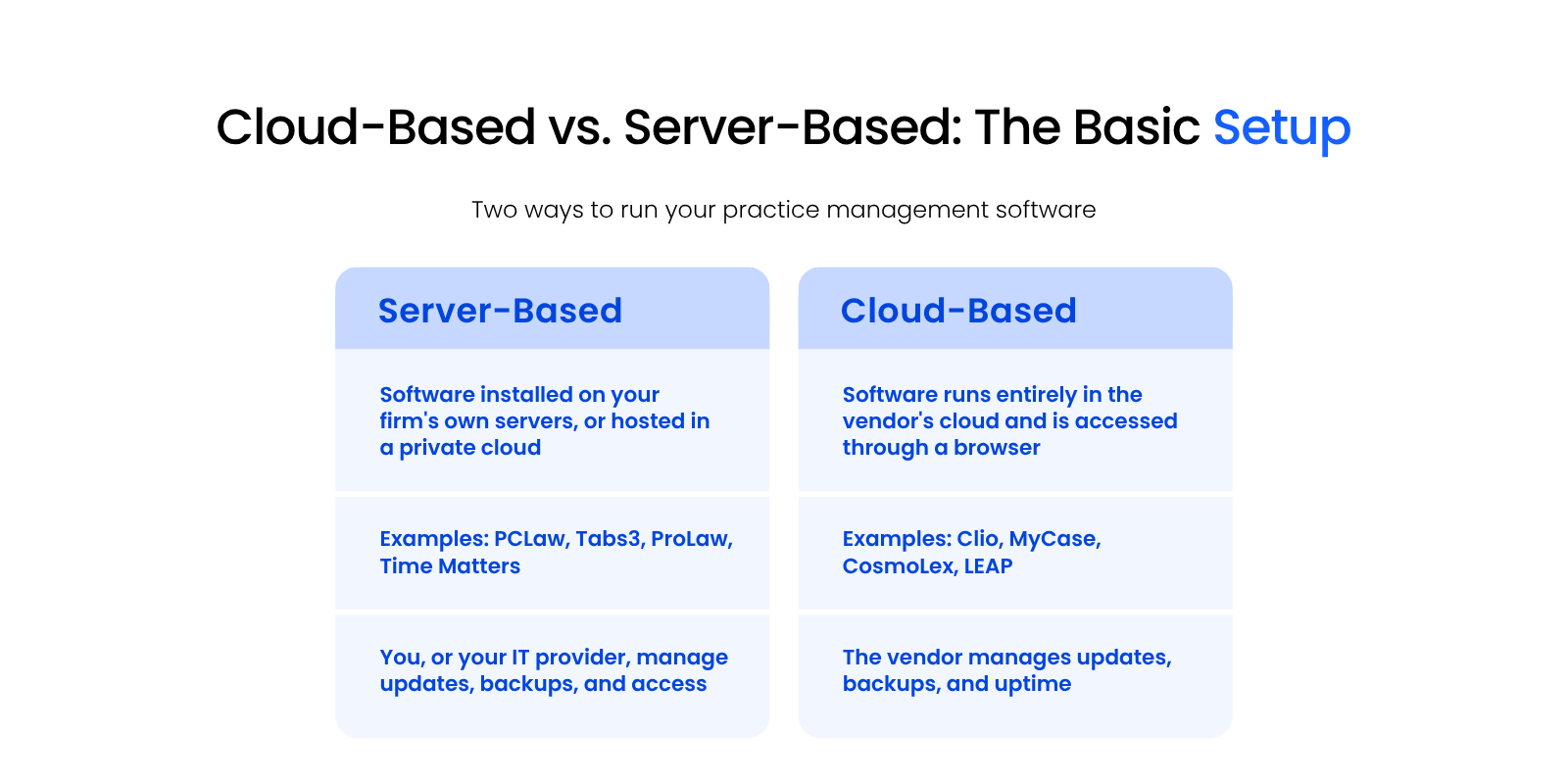
Choosing cloud-based or server-based law practice management software changes who handles your updates and security, and that choice matters as much as which vendor you pick.

Two-column diagram comparing server-based and cloud-based law practice management software setups.

Every platform in this guide falls into one of these two deployment models, and the right one depends on how your firm wants to handle updates, security, and access, not just which features you need.

Why Firms Choose Cloud-Based Software

Cloud-based software gives firms mobility and automatic updates without the upfront cost of servers.

Your team can log in from anywhere with an internet connection, which matters for firms with remote staff or multiple offices. The vendor handles updates, security patches, and uptime, so your firm doesn’t need in-house IT expertise just to keep the software running.

On-prem servers are significantly more riskier and far more often compromised than cloud systems.

— Mike Dewdney, Director of Cloud & IT, Uptime Legal

That’s the opposite of what a lot of firms assume going in. Cloud infrastructure gets continuous security attention at a scale no single firm’s server room can match.

Why Firms Choose Server-Based Software

Server-based software gives firms more control and customization, which matters most for firms with complex or highly specific workflows.

Platforms like ProLaw and Time Matters have decades of legal-specific development behind them, and that depth shows up in configuration options cloud-native tools haven’t built yet. Firms that need tight control over their data, or workflows too specific for an off-the-shelf cloud tool, often find server-based software fits better.

Can You Get Both? The Case for a Private Cloud

A private cloud lets your firm run server-based software like PCLaw or ProLaw while still getting cloud-level accessibility through a virtual desktop.

Migrating to cloud-based software isn’t the only way to get cloud benefits. Server-based software typically packs in more mature features than a firm will use, and giving that up just to gain accessibility is often the wrong trade. A private cloud, hosted through Uptime Cloud’s managed hosting for law firms, hosts your existing software, documents, and email in a secure cloud workspace instead.
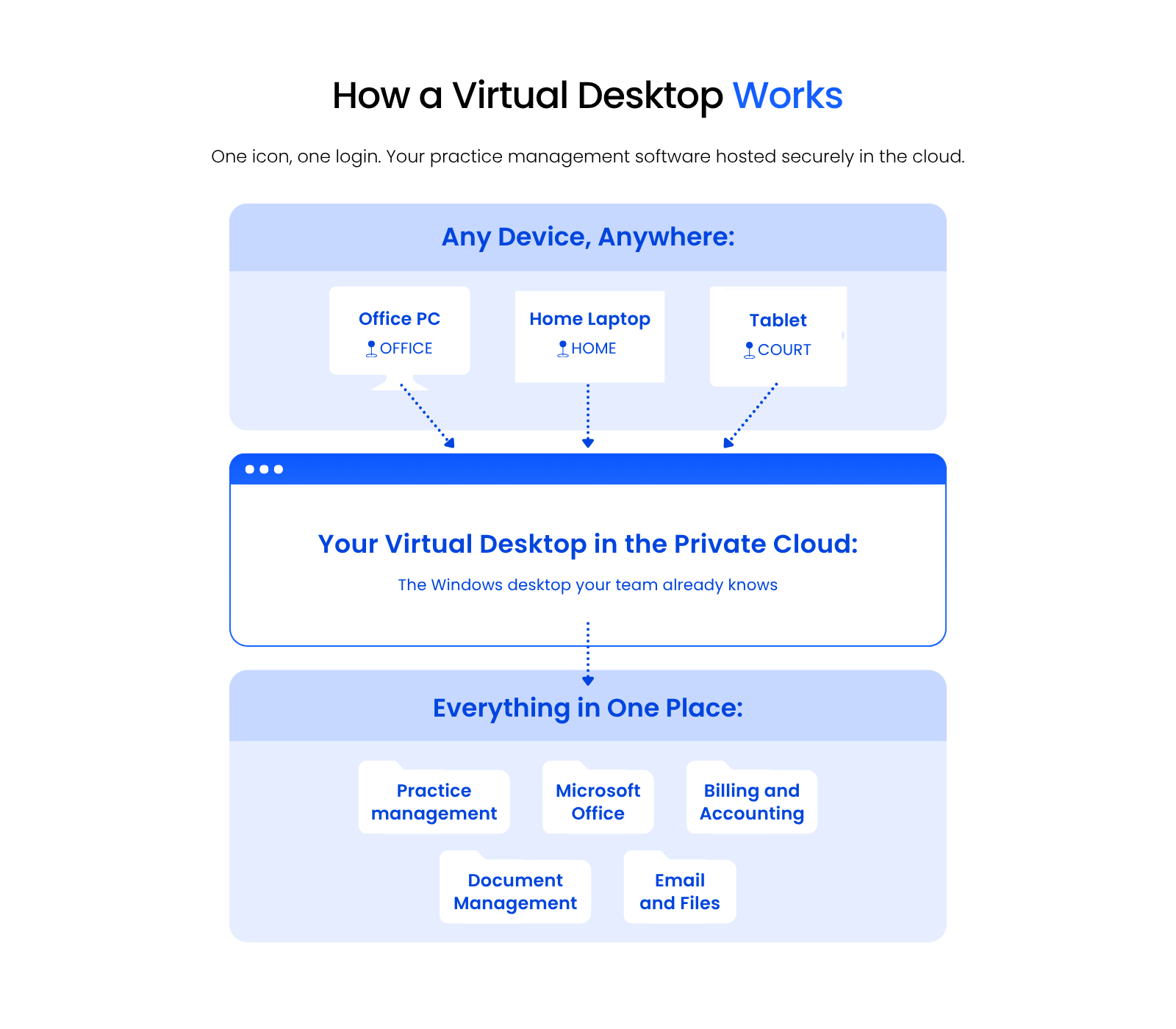
Diagram showing a virtual desktop as a single access point connecting a local device to cloud-hosted software.

A virtual desktop is the access point: one icon on your local desktop that opens directly into your cloud-hosted software, with no separate login process to manage.

How to Decide Between Cloud and Server

Compare features, integrations, and cost against your firm’s actual workflow, not just the vendor’s marketing, before committing to a deployment method.

Whichever platform you choose, make sure it works with how your firm operates day to day, not just how it looks in a demo.

Conclusion

Your Practice Management Software Is a Two-Part Decision

Choosing law practice management software means deciding who runs your infrastructure, you or the vendor, as much as it means picking features.

The platforms in this guide handle case management, billing, and documents well in different ways. What separates a good fit from a bad one is matching that platform, and its deployment method, to how your firm actually works day to day.

Get both parts right, and the software disappears into the background of your firm’s work instead of fighting it.

WHAT’S NEXT

ARTICLE
How to Utilize the 2026 Legal Software Report

FREE ASSESSMENT
Get a Free IT Health Check for Your Firm

GET HELP
See How Uptime Legal Supports Law Firms Day to Day

Frequently Asked Questions

Law practice management software is a unified tool that helps your firm manage case work, document handling, billing, scheduling, and communication in one platform instead of separate tools.

It simplifies administrative tasks, cuts down on billing and scheduling errors, and frees up time for legal work instead of app-switching. That combination shows up directly in productivity and client satisfaction.

Yes. Reputable cloud-based platforms use encryption, multi-factor authentication, and regular security audits to protect your data and meet legal industry compliance expectations.

Most platforms integrate with email, calendar apps, accounting software, and document management tools. Check any platform’s integration list against what your firm already relies on before you commit.

It automates the billing process, tracks billable hours, generates invoices, and monitors payments, which cuts down on manual errors. Some platforms add online payment options so clients can pay directly from an invoice.

Yes. Most platforms on this list offer scalable pricing and features that fit solo practitioners, small firms, and larger multi-location firms alike.

To a degree. Many platforms include document versioning, collaboration, and templates, but if your firm handles high document volume, a dedicated system like LexWorkplace gives you stronger search and organization.

Start with your firm’s specific needs, budget, and preferred deployment method, then look for an intuitive interface, reliable support, and positive reviews from firms your size. A trial or demo makes the difference clear fast.

Clio and MyCase are the most widely adopted cloud-based platforms among small and midsize firms, while PCLaw, ProLaw, and Time Matters remain common at firms that want server-based or private-cloud deployment.

Neither is universally better. Cloud-based software wins on mobility and low maintenance, while server-based software wins on customization and control, and a private cloud can give your firm both.

Published On: September 28th, 2023 / Categories: Cloud Computing, Legal Practice Management, Legal Software Reviews, Legal Technology /

As the founder and CEO of Uptime Legal, I've had the privilege of guiding our company to become a leading provider of technology services for law firms.

Our growth, both organic and through strategic acquisitions, has enabled us to offer a diverse range of services, tailored to the evolving needs of the legal industry.

Being recognized as an Ernst & Young Entrepreneur of the Year Finalist and seeing Uptime Legal ranked among the Inc. 5000 list of fastest-growing private companies in America for eight consecutive years are testaments to our team's dedication.

At Uptime Legal, we strive to continuously innovate and adapt in the rapidly evolving legal tech landscape, ensuring that law firms have access to the most advanced and reliable technology solutions.

Uptime Legal’s Technology Solutions

Cloud, software, IT, and document management built for today’s law firms.

  • Uptime Manage

Managed IT & Help Desk Solutions

  • Uptime Cloud

Cloud & Legal Application Hosting

  • Uptime Applications

Application Configuration & Support

  • LexWorkplace

Document Management For Law Firms